

Volume 12, Issue 1 (Spring 2026)
J Health Res Commun 2026, 12(1): 75-86 |
Back to browse issues page



Download citation:
BibTeX | RIS | EndNote | Medlars | ProCite | Reference Manager | RefWorks
Send citation to:


BibTeX | RIS | EndNote | Medlars | ProCite | Reference Manager | RefWorks
Send citation to:
Zafarzadeh A, Arzamani K, Singh J, Mirkarimi S K. Identification of Cockroach Species and Analysis of Knowledge–Practice Gaps Among Food-Facility Staff in Bojnord City, Northern Khorasan. J Health Res Commun 2026; 12 (1) :75-86
URL: http://jhc.mazums.ac.ir/article-1-1214-en.html
URL: http://jhc.mazums.ac.ir/article-1-1214-en.html


Environmental Health Research Center, Golestan University of Medical Sciences, Gorgan, Iran. & Department of Environmental Health Engineering, School of Health, Golestan University of Medical Sciences, Gorgan, Iran.
Full-Text [PDF 5606 kb]
(130 Downloads)
| Abstract (HTML) (438 Views)
Full-Text: (10 Views)
Introduction
Cockroaches are among the most common and serious urban pests. They act as mechanical vectors of numerous pathogens, including bacteria, protozoa, and viruses, and serve as potent allergens associated with asthma and hypersensitivity reactions [1]. Food-handling establishments, due to constant the availability of food, water, and shelter, provide ideal habitats for cockroach proliferation. Effective pest management requires not only entomological surveillance but also an understanding of human factors, specifically the knowledge, attitudes, and practices (KAP) of food handlers. Previous studies have shown that high infestation rates often stem from a lack of awareness regarding transmission risks [2], and that, even when knowledge is adequate, it may not translate into effective practices [3]. This study aimed to:
a) determine the frequency and species composition of cockroaches infesting food-preparation and distribution centers in Bojnord city, Northern Khorasan Province, Iran;
b) assess the levels of KAP among food-facility staff regarding cockroaches and related health risks;
c) identify gaps between knowledge, attitudes, and actual pest-control behaviors to inform evidence-based interventions.
Methods
This cross-sectional descriptive-analytical study was conducted during the spring and summer of 2023 after receiving ethics approval. The study comprised two phases:
Phase 1) Entomological survey: Using cluster sampling, 211 urban sites were inspected, including restaurants, fast-food shops, hotels, roadside eateries, bakeries, food warehouses, supermarkets, and hospital kitchens. Cockroach infestation was assessed using sticky traps and bait traps placed in areas of high cockroach activity, including inside cabinets, under sinks, behind refrigerators, near waste containers, and along wall margins. Traps were placed one meter apart and collected after one week. Manual catch was also performed. Specimens were transported to the laboratory and identified using valid taxonomic keys [1]. Infestation prevalence was calculated as Equation 1:
1. Infested sites/total sites×100.
Phase 2) KAP survey: A researcher-developed questionnaire was administered to 52 food handlers working in infested sites, defined as sites with at least one cockroach species. Proportional stratified random sampling was applied across eight strata: restaurants (n=13), kebab/fast-food establishments (n=10), hotels (n=5), roadside eateries (n=4), bakeries (n=8), food warehouses (n=3), and supermarkets (n=9). The questionnaire included 15 knowledge items (scored 0–30), 3 attitude items (5-point Likert, range: 3–15), and 5 practice items (4-point Likert, range: 5–20). Scores were categorized as good (>75%), moderate (50–75%), and poor (<50%) [3]. Face and content validity were assessed by a panel of experts, and reliability was confirmed using Cronbach’s alpha (knowledge=0.87, attitude=0.81, and practice=0.92). Informed consent was obtained from all participants.
Data were analyzed using SPSS software, version version 21. Descriptive statistics, independent t-tests, Pearson correlation, linear regression analysis, and chi-square tests were applied, with statistical significance set at P<0.05.
Results
Of the 211 inspected sites, 52 (24.5%) were infested with cockroaches. The highest infestation rate was found in food-production facilities (53.8%, n=28), followed by food-distribution centers (32.6%, n=17), hospital/healthcare kitchens (7.7%, n=4), and other public places (5.7%, n=3). Two species were identified: Blattella germanica (German cockroach) was the dominant species, accounting for 96.5% of all specimens, while Periplaneta americana (American cockroach) comprised only 3.5%. This predominance of B. germanica is consistent with findings from other Iranian cities [4] and is attributed to its high reproductive capacity and environmental adaptability [1].
Among the 52 food handlers surveyed, 63.5% were male and 36.5% female. The Mean age was 38.66 years. Educational levels were as follows: illiterate, 13.5%; middle school, 23.1%; high school diploma, 38.5%; and university education, 25.0%.
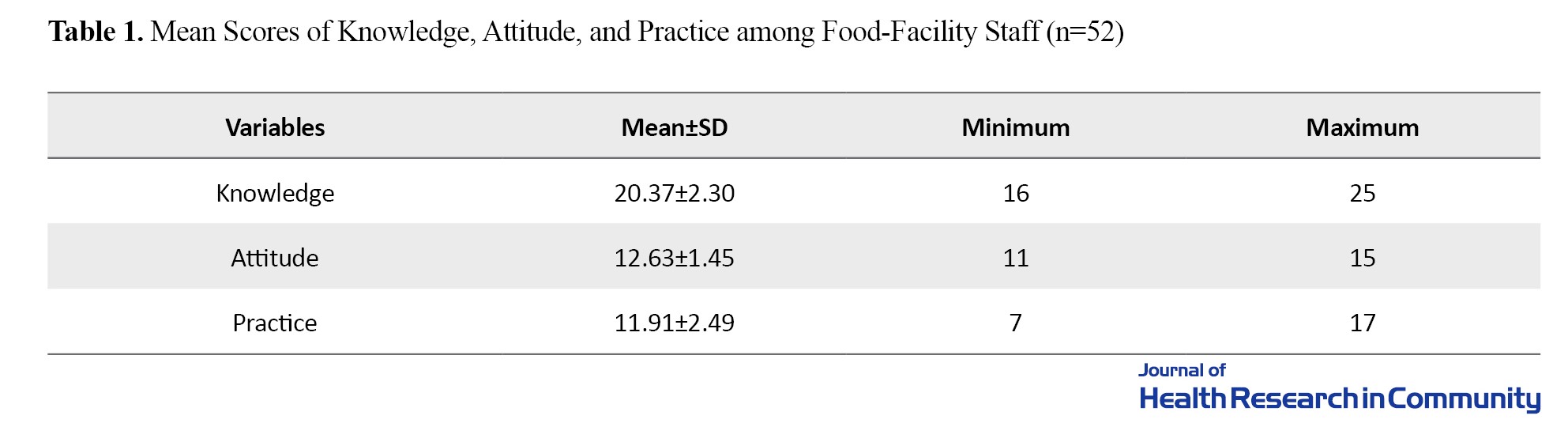
The mean knowledge score (20.37±2.30) indicated moderate to high knowledge, and the mean attitude score (12.63±1.45) reflected favorable attitudes. However, the mean practice score (11.91±2.49) was poor and showed the greatest variability among the three variables, indicating substantial diversity in actual pest-control behaviors (Table 1).
These findings are similar to those reported by previous studies [3], where adequate knowledge did not translate into effective practiced. Linear regression analysis showed that for each one-unit increase in knowledge, the practice increased by 0.218 units (β=0.218, P=0.233), and for each one-unit increase in attitude, the practice increased by 0.268 units (β=0.268, P=0.145). Although both knowledge and attitude had positive relationships with practice, neither relationship was statistically significant (P>0.05)
Conclusion
The overall infestation rate (24.5%) and the predominance of B. germanica (96.5%) in Bojnord are consistent with findings from other Iranian cities, such as Yasuj [4], although the rate is lower than that in warmer, more humid regions such as Ahvaz because of climatic differences (temperate mountainous versus hot and humid) [4]. The high infestation rate in food-production facilities underscores the critical role of kitchens as primary habitats for cockroaches, driven by food residues, moisture, and darkness.
The most striking finding is the clear disconnect between moderate-to-high knowledge and favorable attitudes, on the one hand, and poor practices, on the other. This knowledge–practice gap, which has also been reported internationally [5], suggests that merely providing information is insufficient to change behavior. Practical barriers likely include limited access to effective control tools, inadequate environmental hygiene, a lack of hands-on training, and insufficient supervision [3]. As noted by Nasirian [2], successful cockroach control requires converting awareness into effective performance through continuous practical interventions. These results emphasize the urgent need for targeted practical training, the provision of proper pest-control equipment, and continuous monitoring—not just awareness campaigns—to achieve sustainable cockroach management.
Ethical Considerations
Compliance with ethical guidelines
This study was approved by the Ethics Committee of Golestan University of Medical Sciences (Code: IR.GOUMS.REC.1401.073). All participants provided written informed consent. Data were collected anonymously and kept confidential.
Funding
This research was funded by Golestan University of Medical Sciences and North Khorasan University of Medical Sciences (Gtand No.:: 112497).
Authors contributions
Conceptualization, design: Ali Zafarzadeh; Data collection: Kourosh Arzamani; Data analysis and interpretation: Ali Zafarzadeh and Kourosh Arzamani; Writing, statistical analysis, editing & review: Seyed Kamal Mirkarimi, Ali Zafarzadeh, and Jaswant Singh.
Conflicts of interest
The authors declared no conflicts of interest.
Acknowledgments
The authors would like to thank Hamid Reza Shorka, Ahmad Mousazadeh, and Fatemeh Kohestani for their assistance in conducting this study.
Cockroaches are among the most common and serious urban pests. They act as mechanical vectors of numerous pathogens, including bacteria, protozoa, and viruses, and serve as potent allergens associated with asthma and hypersensitivity reactions [1]. Food-handling establishments, due to constant the availability of food, water, and shelter, provide ideal habitats for cockroach proliferation. Effective pest management requires not only entomological surveillance but also an understanding of human factors, specifically the knowledge, attitudes, and practices (KAP) of food handlers. Previous studies have shown that high infestation rates often stem from a lack of awareness regarding transmission risks [2], and that, even when knowledge is adequate, it may not translate into effective practices [3]. This study aimed to:
a) determine the frequency and species composition of cockroaches infesting food-preparation and distribution centers in Bojnord city, Northern Khorasan Province, Iran;
b) assess the levels of KAP among food-facility staff regarding cockroaches and related health risks;
c) identify gaps between knowledge, attitudes, and actual pest-control behaviors to inform evidence-based interventions.
Methods
This cross-sectional descriptive-analytical study was conducted during the spring and summer of 2023 after receiving ethics approval. The study comprised two phases:
Phase 1) Entomological survey: Using cluster sampling, 211 urban sites were inspected, including restaurants, fast-food shops, hotels, roadside eateries, bakeries, food warehouses, supermarkets, and hospital kitchens. Cockroach infestation was assessed using sticky traps and bait traps placed in areas of high cockroach activity, including inside cabinets, under sinks, behind refrigerators, near waste containers, and along wall margins. Traps were placed one meter apart and collected after one week. Manual catch was also performed. Specimens were transported to the laboratory and identified using valid taxonomic keys [1]. Infestation prevalence was calculated as Equation 1:
1. Infested sites/total sites×100.
Phase 2) KAP survey: A researcher-developed questionnaire was administered to 52 food handlers working in infested sites, defined as sites with at least one cockroach species. Proportional stratified random sampling was applied across eight strata: restaurants (n=13), kebab/fast-food establishments (n=10), hotels (n=5), roadside eateries (n=4), bakeries (n=8), food warehouses (n=3), and supermarkets (n=9). The questionnaire included 15 knowledge items (scored 0–30), 3 attitude items (5-point Likert, range: 3–15), and 5 practice items (4-point Likert, range: 5–20). Scores were categorized as good (>75%), moderate (50–75%), and poor (<50%) [3]. Face and content validity were assessed by a panel of experts, and reliability was confirmed using Cronbach’s alpha (knowledge=0.87, attitude=0.81, and practice=0.92). Informed consent was obtained from all participants.
Data were analyzed using SPSS software, version version 21. Descriptive statistics, independent t-tests, Pearson correlation, linear regression analysis, and chi-square tests were applied, with statistical significance set at P<0.05.
Results
Of the 211 inspected sites, 52 (24.5%) were infested with cockroaches. The highest infestation rate was found in food-production facilities (53.8%, n=28), followed by food-distribution centers (32.6%, n=17), hospital/healthcare kitchens (7.7%, n=4), and other public places (5.7%, n=3). Two species were identified: Blattella germanica (German cockroach) was the dominant species, accounting for 96.5% of all specimens, while Periplaneta americana (American cockroach) comprised only 3.5%. This predominance of B. germanica is consistent with findings from other Iranian cities [4] and is attributed to its high reproductive capacity and environmental adaptability [1].
Among the 52 food handlers surveyed, 63.5% were male and 36.5% female. The Mean age was 38.66 years. Educational levels were as follows: illiterate, 13.5%; middle school, 23.1%; high school diploma, 38.5%; and university education, 25.0%.
The mean knowledge score (20.37±2.30) indicated moderate to high knowledge, and the mean attitude score (12.63±1.45) reflected favorable attitudes. However, the mean practice score (11.91±2.49) was poor and showed the greatest variability among the three variables, indicating substantial diversity in actual pest-control behaviors (Table 1).
These findings are similar to those reported by previous studies [3], where adequate knowledge did not translate into effective practiced. Linear regression analysis showed that for each one-unit increase in knowledge, the practice increased by 0.218 units (β=0.218, P=0.233), and for each one-unit increase in attitude, the practice increased by 0.268 units (β=0.268, P=0.145). Although both knowledge and attitude had positive relationships with practice, neither relationship was statistically significant (P>0.05)
Conclusion
The overall infestation rate (24.5%) and the predominance of B. germanica (96.5%) in Bojnord are consistent with findings from other Iranian cities, such as Yasuj [4], although the rate is lower than that in warmer, more humid regions such as Ahvaz because of climatic differences (temperate mountainous versus hot and humid) [4]. The high infestation rate in food-production facilities underscores the critical role of kitchens as primary habitats for cockroaches, driven by food residues, moisture, and darkness.
The most striking finding is the clear disconnect between moderate-to-high knowledge and favorable attitudes, on the one hand, and poor practices, on the other. This knowledge–practice gap, which has also been reported internationally [5], suggests that merely providing information is insufficient to change behavior. Practical barriers likely include limited access to effective control tools, inadequate environmental hygiene, a lack of hands-on training, and insufficient supervision [3]. As noted by Nasirian [2], successful cockroach control requires converting awareness into effective performance through continuous practical interventions. These results emphasize the urgent need for targeted practical training, the provision of proper pest-control equipment, and continuous monitoring—not just awareness campaigns—to achieve sustainable cockroach management.
Ethical Considerations
Compliance with ethical guidelines
This study was approved by the Ethics Committee of Golestan University of Medical Sciences (Code: IR.GOUMS.REC.1401.073). All participants provided written informed consent. Data were collected anonymously and kept confidential.
Funding
This research was funded by Golestan University of Medical Sciences and North Khorasan University of Medical Sciences (Gtand No.:: 112497).
Authors contributions
Conceptualization, design: Ali Zafarzadeh; Data collection: Kourosh Arzamani; Data analysis and interpretation: Ali Zafarzadeh and Kourosh Arzamani; Writing, statistical analysis, editing & review: Seyed Kamal Mirkarimi, Ali Zafarzadeh, and Jaswant Singh.
Conflicts of interest
The authors declared no conflicts of interest.
Acknowledgments
The authors would like to thank Hamid Reza Shorka, Ahmad Mousazadeh, and Fatemeh Kohestani for their assistance in conducting this study.
References
- Hashemi-Aghdam SS, Oshaghi MA. A checklist of Iranian cockroaches (Blattodea) with description of Polyphaga sp as a new species in Iran. J Arthropod Borne Dis. 2015; 9(2):161-75. [PMID]
- Chitsazi S, Moravvej G, Naderinasab M. [Fauna of bacteria and fungi associated with digestive system of Blattela germanica L. collected from various locations in Mashhad, Iran (Persian)]. Iran J Med Microbiol. 2013; 6(4):16-26. [Link]
- Rahimian AA, Hanafi-Bojd AA, Vatandoost H, Zaim M. A review on the insecticide resistance of three species of cockroaches (Blattodea: Blattidae) in Iran. J Econ Entomol. 2019; 112(1):1-10. [DOI:10.1093/jee/toy247] [PMID]
- Moghadam MJ, Nozari J, Latifian M, Pezhman S, Shirmardi SM. [Evaluation of Geographical Distribution and Establishment Risk of Cockroach Species in Warehouses of Six Date-Producing Provinces of Iran (Persian)]. J Mil Med. 2024; 26(2):2277-87. [DOI:10.30491/jmm.2024.1006643.1156]
- Shahraki GH, Parhizkar S, Raygan Shirazi Nejad A. Cockroach infestation and factors affecting the estimation of cockroach population in urban communities. Int J Zool. 2013; 2013(1):649089. [DOI:10.1155/2013/649089]
- Jalil N, Keyhani A, Hasan MKS, Mahdi M, Monireh M, Atefeh B. Cockroaches’ bacterial infections in wards of hospitals, Hamedan city, west of Iran. Asian Pac J Trop Dis. 2012; 2(5):381-4. [DOI:10.1016/S2222-1808(12)60083-8]
- Sharififard M, Jahanifard E, Alizadeh I, Malehi A. [Investigation of species composition and prevalence rate of cockroaches in residential buildings of Ahvaz city in 2016-2017 (Persian)]. J Health Res Commun. 2020; 6(1):1-13. [Link]
- Kassiri H, Kassiri A, Kazemi S. Investigation on American cockroaches medically important bacteria in Khorramshahr hospital, Iran. Asian Pac J Trop Dis. 2014; 4(3):201-3. [DOI:10.1016/S2222-1808(14)60505-3] [PMCID]
- Motevalli Haghi SF, Hosseini Vasoukolaei N, Ahmadian MT, Yazdani Charati J, Nikookar SH. [Knowledge, Attitude, and Practice of Rural Households in Bojnourd, Iran Regarding the Fleas (Persian)]. Qom Univ Med Sci J. 2023, 17(1):235-48. [DOI:10.32598/qums.17.2477.2]
- Bamigboye A. Rat infestation in a typical Nigerian University Halls of residence: Implications for hygiene and sanitation. Res J Agric Biol Sci. 2006; 2(6):328-31. [Link]
- Bradman A, Chevrier J, Tager I, Lipsett M, Sedgwick J, Macher J, et al. Association of housing disrepair indicators with cockroach and rodent infestations in a cohort of pregnant Latina women and their children. Environ Health Perspect. 2005; 113(12):1795-801. [DOI:10.1289/ehp.7588] [PMID]
- Wang C, Abou El-Nour MM, Bennett GW. Survey of pest infestation, asthma, and allergy in low-income housing. J Community Health. 2008; 33(1):31-9. [DOI:10.1007/s10900-007-9064-6] [PMID]
- Ngwawe CO. Assessment of cockroach infestation levels, awareness and control practices of vendors in ready-to-eat food premises in Kisumu city, Kisumu county [PhD dissertation]. Kisumu: Maseno University; 2017. [Link]
- Hopkins H. A revision of the genus Arenivaga (Rehn)(Blattodea, Corydiidae), with descriptions of new species and key to the males of the genus. Zookeys. 2014; (384):1-256. [DOI:10.3897/zookeys.384.6197] [PMID]
- Nsaful J, Appiah YB, Nartey ET. Knowledge, attitude and practice on breast cancer screening among female nurses in a tertiary hospital in Ghana. Health Sci Investig J. 2025; 7(1):1041-9. [DOI:10.46829/hsijournal.2025.6.7.1.1041-1049]
- Hajizadeh E, Asghari M. [Methods and analyses through research method in bio and health science (Persian)]. Tehran: Jahad Daneshgahi publication; 2011. [Link]
- Dehghani R, Atharizadeh M, Moosavi SG, Azadi S, Rashidi M, Paksa A. Analysis of cockroach fauna and frequency in human residential habitats of North of Isfahan, Iran. Int Arch Health Sci. 2014; 1(1):25-9. [Link]
- Khoobdel M, Dehghan H, Nikookar SH, Moradi M. Methods of prevention and control of German and brown-banded cockroaches in human habitats: A systematic review. J Health Res Commun. 2021; 7(3):89-114. [Link]
- Nasirian H. Recent cockroach bacterial contamination trend in the human dwelling environments: A systematic review and meta-analysis. Bangladesh J Med Sci. 2019; 18(3):540-5. [DOI:10.3329/bjms.v18i3.41623]
- Memona H, Manzoor F, Riaz S. Species Diversity and Distributional Pattern of Cockroaches in Lahore, Pakistan. J Arthropod Borne Dis. 2017; 11(2):249-59. [PMID]
- Appel AG, Reierson DA, Rust MK. Comparative water relations and temperature sensitivity of cockroaches. Comp Biochem Physiol. 2008; 74(2):357-61. [DOI:10.1016/0300-9629(83)90615-1]
- Wang C, Bischoff E, Eiden AL, Zha C, Cooper R, Graber JM. Residents attitudes and home sanitation predict presence of German cockroaches (Blattodea: Ectobiidae) in apartments for low-income senior residents. J Econ Entomol. 2019; 112(1):284-9. [DOI:10.1093/jee/toy307] [PMID]
- Chrispine O, Awiti L. Assessment of Cockroach Infestation Levels, Awareness and Control Practices of Vendors in Ready-To-Eat Food Premises in Kisumu City, Kisumu County, Kenya. Am J Humanit Soc Sci Res. 2019; 3(3):63-76. [Link]
- Leibovich-Raveh T, Gish M. Does insect aversion lead to increased household pesticide use? Insects. 2022; 13(6):555. [DOI:10.3390/insects13060555] [PMID]
- Seaman P, Eves A. Perceptions of hygiene training amongst food handlers, managers and training providers-A qualitative study. Food Control. 2010; 21(7):1037-41. [DOI:10.1016/j.foodcont.2009.12.024]
Type of Study: Research(Original) |
Subject:
Medical Entomology
Send email to the article author
| Rights and permissions | |
 |
This work is licensed under a Creative Commons Attribution-NonCommercial 4.0 International License. |
