

Volume 12, Issue 2 (Summer 2026)
J Health Res Commun 2026, 12(2): 198-208 |
Back to browse issues page



Download citation:
BibTeX | RIS | EndNote | Medlars | ProCite | Reference Manager | RefWorks
Send citation to:


BibTeX | RIS | EndNote | Medlars | ProCite | Reference Manager | RefWorks
Send citation to:
Ghaljahi M. Priority Organizational Interventions for Reducing Occupational Stress in Firefighters: A Policy Brief. , J Health Res Commun. 2026; 12 (2) :198-208
URL: http://jhc.mazums.ac.ir/article-1-1259-en.html
URL: http://jhc.mazums.ac.ir/article-1-1259-en.html


Department of Occupational Health Engineering, School of Public Health, Zabol University of Medical Sciences, Zabol, Iran.
Keywords: Occupational stress, Firefighters, Zabol, HSE questionnaire, Organizational support, Policy brief
Full-Text [PDF 4512 kb]
(55 Downloads)
| Abstract (HTML) (885 Views)
Full-Text: (48 Views)
Introduction
Occupational stress is among the most critical occupational health hazards in emergency response professions. Firefighters are disproportionately exposed to this risk due to their recurrent encounters with life-threatening incidents, emergency conditions, intense time pressures, and demanding responsibilities. In their joint guidelines, the World Health Organization (WHO) and the International Labour Organization (ILO) underscore the necessity of implementing organizational interventions to prevent and manage psychosocial hazards in the workplace. Accordingly, the primary strategy for reducing occupational stress among firefighters should center on organizational-level interventions, including strengthening managerial support, clarifying job roles and responsibilities, improving shift-work systems, enhancing employee participation in decision-making, and cultivating a supportive organizational culture. Within this framework, stress management training and resilience-building programs should be incorporated as one component of a comprehensive intervention package alongside organizational reforms rather than serving as the principal focus of intervention efforts [1, 2].
In underserved provinces, such as Sistan and Baluchestan, resource limitations, the lack of systematic psychological support programs, and the absence of continuous occupational stress monitoring pose additional challenges to the effective management of this hazard. Informed by the findings of the aforementioned study and a review of credible national and international evidence, this policy brief examined feasible policy options for mitigating occupational stress among firefighters and proposed priority interventions tailored to the specific context of Zabol, offering recommendations to policymakers and administrators in public health and urban management.
Methods
This policy brief was developed based on the findings of an analytical cross-sectional study approved by Zabol University of Medical Sciences, alongside a comprehensive review of credible national and international research evidence. Data were collected using the standardized Health and Safety Executive (HSE) Job Stress Questionnaire (HSE JQ). To inform the development of this brief, relevant research evidence was synthesized from reputable domestic and international sources, including systematic reviews, meta-analyses, high-quality observational studies, and policy documents issued by authoritative organizations, such as the WHO, the ILO, and the National Institute for Occupational Safety and Health (NIOSH). The evidence search was specifically focused on effective interventions for the management of occupational stress among firefighters and other emergency response personnel. The proposed policy options were subsequently prioritized based on their effectiveness, feasibility, cost, organizational acceptability, and suitability for the specific context of Zabol County.
Proposed Intervention Package
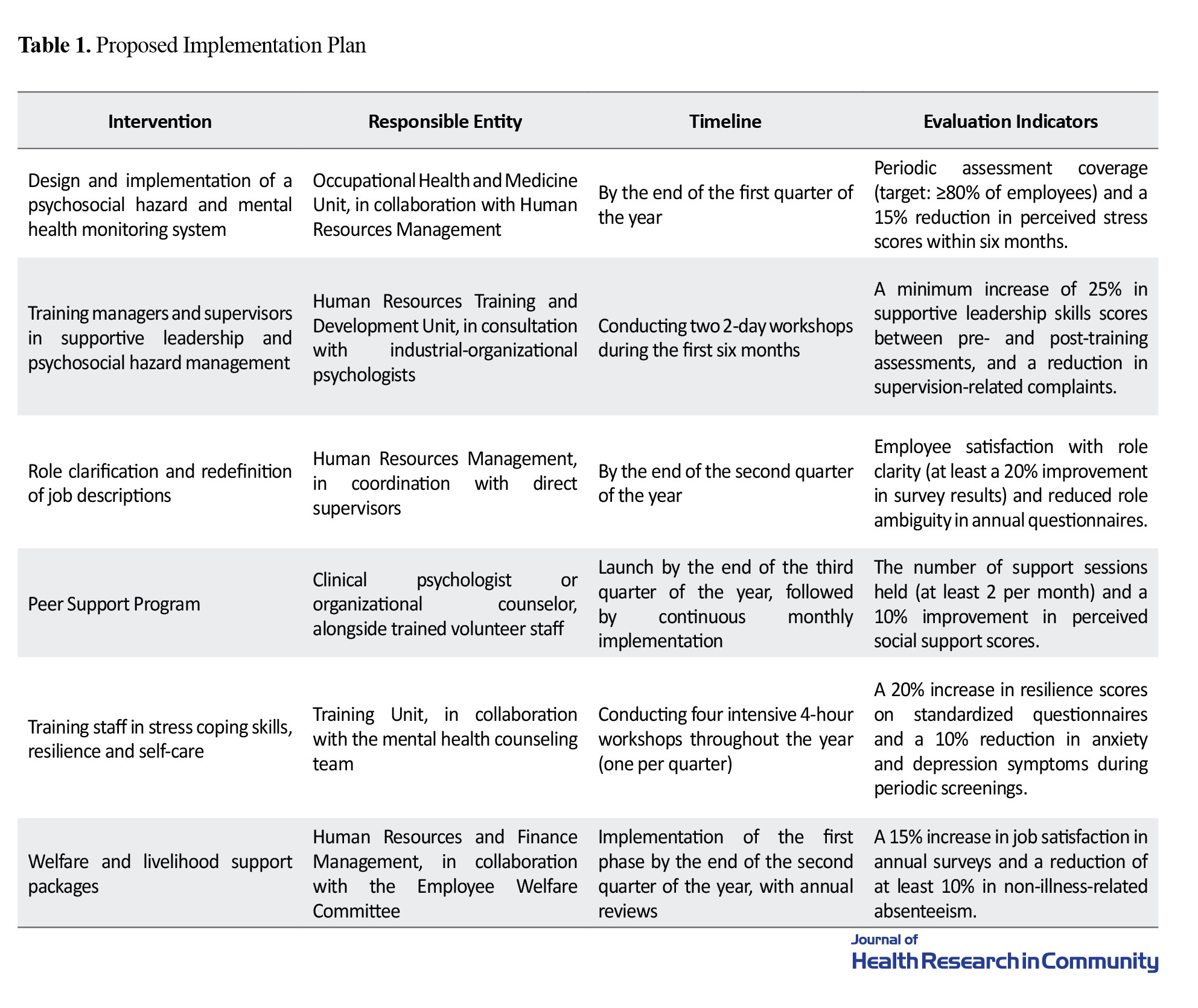
The following four options are proposed as priority interventions for the Zabol Fire Department: organizational reforms (role clarification), management training, a peer support program, and a psychosocial hazard and mental health monitoring system.
Conclusion
Occupational stress among the surveyed firefighters, particularly in the domains of occupational role and managerial support, warrants greater attention from organizational leadership and occupational health policymakers. Given the cross-sectional design of this study, the findings are primarily applicable for identifying intervention priorities within the Zabol Fire Department and caution should be exercised when generalizing them to other contexts. Drawing on the evidence from this study and a review of credible literature, implementing a comprehensive intervention package encompassing role clarification, stress management skills training, strengthening managerial and peer support, and establishing a system for the periodic monitoring of occupational stress can contribute to improved management of psychosocial hazards within the fire service organization.
Ethical Considerations
Compliance with ethical guidelines
This study was approved by Zabol University of Medical Sciences (Code: IR.ZBMU.REC.1399.056).
Funding
This research did not receive any specific grant from funding agencies in the public, commercial, or not-for-profit sectors.
Conflicts of interest
The authors declared no conflict of interest.
Acknowledgments
The authors would like to thank all firefighters in Zabol County who participated in this study, as well as to the officials of the selected Fire Department for their cooperation during data collection.
Occupational stress is among the most critical occupational health hazards in emergency response professions. Firefighters are disproportionately exposed to this risk due to their recurrent encounters with life-threatening incidents, emergency conditions, intense time pressures, and demanding responsibilities. In their joint guidelines, the World Health Organization (WHO) and the International Labour Organization (ILO) underscore the necessity of implementing organizational interventions to prevent and manage psychosocial hazards in the workplace. Accordingly, the primary strategy for reducing occupational stress among firefighters should center on organizational-level interventions, including strengthening managerial support, clarifying job roles and responsibilities, improving shift-work systems, enhancing employee participation in decision-making, and cultivating a supportive organizational culture. Within this framework, stress management training and resilience-building programs should be incorporated as one component of a comprehensive intervention package alongside organizational reforms rather than serving as the principal focus of intervention efforts [1, 2].
In underserved provinces, such as Sistan and Baluchestan, resource limitations, the lack of systematic psychological support programs, and the absence of continuous occupational stress monitoring pose additional challenges to the effective management of this hazard. Informed by the findings of the aforementioned study and a review of credible national and international evidence, this policy brief examined feasible policy options for mitigating occupational stress among firefighters and proposed priority interventions tailored to the specific context of Zabol, offering recommendations to policymakers and administrators in public health and urban management.
Methods
This policy brief was developed based on the findings of an analytical cross-sectional study approved by Zabol University of Medical Sciences, alongside a comprehensive review of credible national and international research evidence. Data were collected using the standardized Health and Safety Executive (HSE) Job Stress Questionnaire (HSE JQ). To inform the development of this brief, relevant research evidence was synthesized from reputable domestic and international sources, including systematic reviews, meta-analyses, high-quality observational studies, and policy documents issued by authoritative organizations, such as the WHO, the ILO, and the National Institute for Occupational Safety and Health (NIOSH). The evidence search was specifically focused on effective interventions for the management of occupational stress among firefighters and other emergency response personnel. The proposed policy options were subsequently prioritized based on their effectiveness, feasibility, cost, organizational acceptability, and suitability for the specific context of Zabol County.
Proposed Intervention Package
The following four options are proposed as priority interventions for the Zabol Fire Department: organizational reforms (role clarification), management training, a peer support program, and a psychosocial hazard and mental health monitoring system.
Conclusion
Occupational stress among the surveyed firefighters, particularly in the domains of occupational role and managerial support, warrants greater attention from organizational leadership and occupational health policymakers. Given the cross-sectional design of this study, the findings are primarily applicable for identifying intervention priorities within the Zabol Fire Department and caution should be exercised when generalizing them to other contexts. Drawing on the evidence from this study and a review of credible literature, implementing a comprehensive intervention package encompassing role clarification, stress management skills training, strengthening managerial and peer support, and establishing a system for the periodic monitoring of occupational stress can contribute to improved management of psychosocial hazards within the fire service organization.
Ethical Considerations
Compliance with ethical guidelines
This study was approved by Zabol University of Medical Sciences (Code: IR.ZBMU.REC.1399.056).
Funding
This research did not receive any specific grant from funding agencies in the public, commercial, or not-for-profit sectors.
Conflicts of interest
The authors declared no conflict of interest.
Acknowledgments
The authors would like to thank all firefighters in Zabol County who participated in this study, as well as to the officials of the selected Fire Department for their cooperation during data collection.
References
- Armoon B, Hosseini Koukamari P, Rouhani MR, Gharegozloo L, Karimy M, Coetzer-Liversage A. Comparison of Quality of Life and Coping Strategies among Firefighters and Emergency Medical Services Personnel in Saveh, Iran. New Solut. 2024; 34(2):120-32. [DOI:10.1177/10482911241258256] [PMID]
- World Health Organization. WHO guidelines on mental health at work. Geneva: World Health Organization; 2022. [Link]
- Gharibi V, Malakouti J, Arsang Jang S, Gholami A. [Prevalence of occupational stress and its relationship to individual characteristics in tunneling industry workers (Perian)]. J Health Syst Res. 2013; 9(1):57-65. [Link]
- Zeraat Herfeh F, Shamsi Nejad M, Rahmati A. [Psychological consequences of firefighters’ working conditions: A Qualitative Study (Persian)]. Occup Med. 2021; 13(3):77-91. [DOI:10.18502/tkj.v13i3.8201]
- World Health Organization. WHO and ILO call for new measures to tackle mental health issues at work. Geneva: World Health Organization; 2022. [Link]
- Mackay L, Campbell JL, Darby J, Pendergast K, Schofield G. Associations between exposure to potentially psychologically traumatic events and mental ill health among New Zealand firefighters: A cross-sectional study. Compr Psychiatry. 2025; 139:152595. [DOI:10.1016/j.comppsych.2025.152595] [PMID]
- Stanley IH, Hom MA, Joiner TE. A systematic review of suicidal thoughts and behaviors among police officers, firefighters, EMTs, and paramedics. Clin Psychol Rev. 2016; 44:25-44. [DOI:10.1016/j.cpr.2015.12.002] [PMID]
- Wiegand DM, Chiu SK, Broadwater K, Li JF. A Cross-Sectional Evaluation of City Firefighters' Exposure to Potentially Traumatic Events During Opioid Overdose Responses and Mental Health. J Workplace Behav Health. 2025; 40(3):415-32. [DOI:10.1080/15555240.2024.2390018] [PMID]
- Howard J, Houry D. Protecting the Mental Health and Well-Being of the Nation's Health Workforce. Am J Public Health. 2024; 114(S2):137-41. [DOI:10.2105/AJPH.2023.307475] [PMID]
- Rajabi F, Molaeifar H, Jahangiri M, Taheri S, Banaee S, Farhadi P. Occupational stressors among firefighters: application of multi-criteria decision making (MCDM)Techniques. Heliyon. 2020; 6(4):e03820. [DOI:10.1016/j.heliyon.2020.e03820] [PMID]
- Ziaei M, Yarmohammadi H, Izadi Laybidi M, Nazari Z, Hashemian AH. Comparison of occupational stress among personnel of firefighting and emergency medical stations of Kermanshah (Iran) in 2013. World J Med Sci. 2014; 10(3):362-7. [Link]
- Baghianimoghadam MH, Hatamzadeh N, Sharifi M, Mehrabbeiki A, Ardian N. Investigation of Job Stress and Related Factors in Firefighters in the Cities of Ahvaz and Yazd, Iran . Caspian J Health Res. 2015; 1(1):27-34 [DOI:10.18869/acadpub.cjhr.1.1.27]
Type of Study: Brief Report |
Subject:
Occupational Health
Send email to the article author
| Rights and permissions | |
 |
This work is licensed under a Creative Commons Attribution-NonCommercial 4.0 International License. |
