

Volume 12, Issue 1 (Spring 2026)
J Health Res Commun 2026, 12(1): 87-99 |
Back to browse issues page



Download citation:
BibTeX | RIS | EndNote | Medlars | ProCite | Reference Manager | RefWorks
Send citation to:


BibTeX | RIS | EndNote | Medlars | ProCite | Reference Manager | RefWorks
Send citation to:
Darskhan M, Lotfi Kashani F, Vaziri S, Tavakol M. Effect of Self-Affirmation Interviews on the Quality of life of Individuals With Asthma. J Health Res Commun 2026; 12 (1) :87-99
URL: http://jhc.mazums.ac.ir/article-1-1213-en.html
URL: http://jhc.mazums.ac.ir/article-1-1213-en.html


Department of Psychology, TMS.C., Islamic Azad University, Tehran, Iran
Full-Text [PDF 4847 kb]
(58 Downloads)
| Abstract (HTML) (426 Views)
References
Full-Text: (11 Views)
Introduction
Asthma is recognized as one of the most common diseases causing disability and mortality in human societies [22], and it also imposes substantial social and psychological costs on patients [23]. Therefore, it is necessary to reduce these costs by addressing manipulable variables, such as quality of life, among people with asthma. Clearly, understanding the problems and mental health of people with asthma is important and should be a priority for health policymakers. Despite the importance of this issue in the country, no comprehensive effort has been made to address it. Therefore, the author’s concern was to investigate the process of improving the quality of life of people with asthma. The use of psychological interventions to address psychological correlates is, therefore, an undeniable necessity. Also, therapists, counselors, and psychologists can use the findings of this study as intervention strategies to improve the quality of life and health of people with asthma and address factors related to the disease. As a result, such efforts may help strengthen family relationships and improve patients’ functioning in society. Therefore, the present study aimed to investigate the effect of self-affirmation interviews on the quality of life of people with asthma.
Methods
In the present study, an intervention design with a pre-test, post-test, and control group, along with a two-month follow-up phase, was used. The statistical population consisted of all asthma patients who had visited the Asthma and Allergy Specialty Clinic in Karaj during the second half of 2024. Among them, 40 individuals were randomly assigned to two groups of 20 participants each: an experimental group and a control group.
Participants completed a demographic information checklist and the Asthma Quality of Life Questionnaire (Marks et al., 1993) [25]. The experimental group received the self-affirmation interview intervention in five 90-minute group sessions, with one session held per week.
Data analysis was performed utilizing SPSS software, version 24 software and described using percentages, frequencies, means, standard deviations. The Kolmogorov–Smirnov test, Mauchly’s test of sphericity, the conservative Greenhouse–Geisser correction, repeated-measures analysis of variance, and the Bonferroni test were used for data analyses.
Results
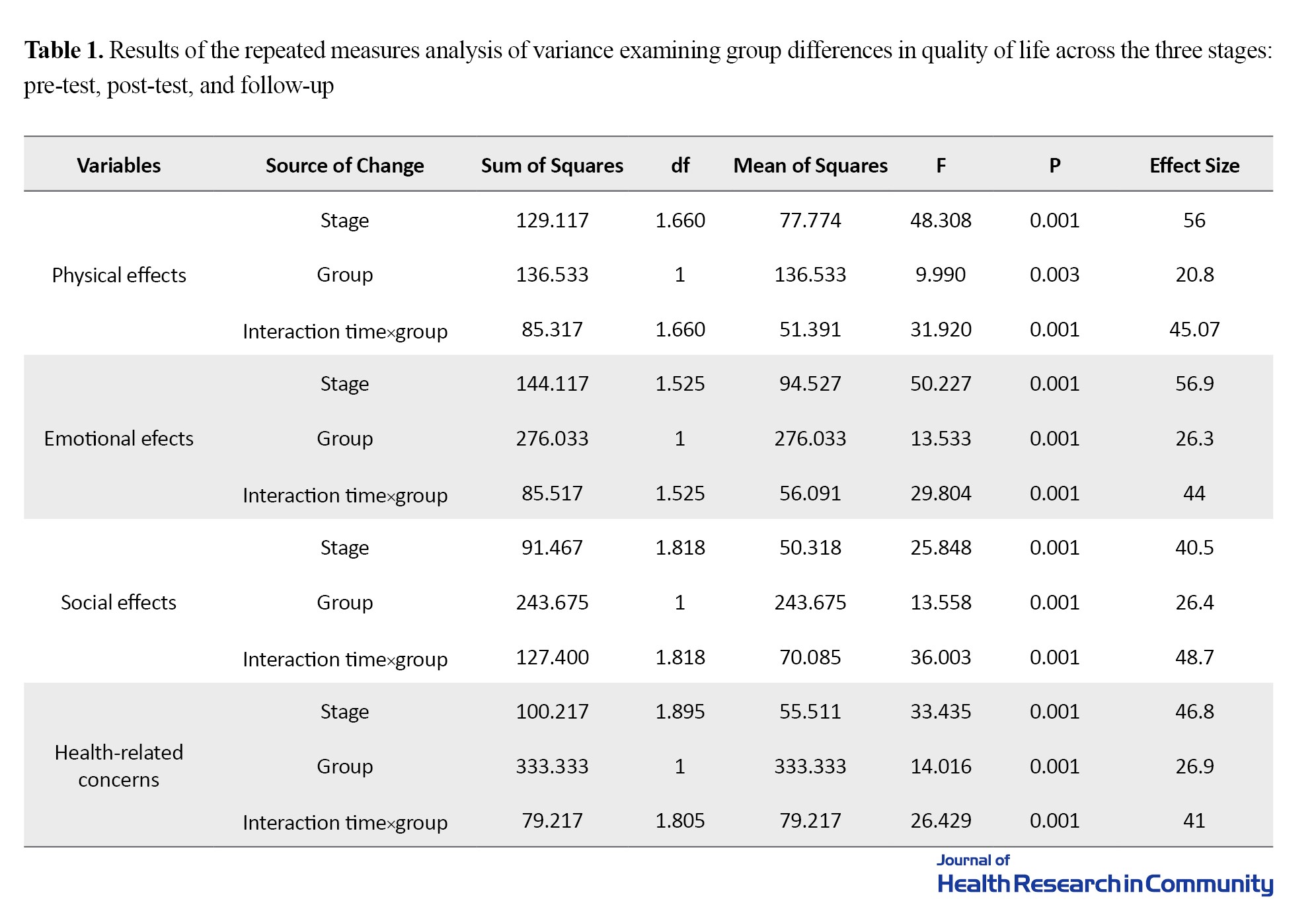
According to the results, 13 women, representing 65% of the experimental group, participated in the study, and the participants were between 46 and 60 years of age. In the control group, 11 women, representing 55% of the group, participated in the study, and the participants were also between 46 and 60 years of age. The results showed significant differences between the two groups in all quality-of-life components—physical effects, emotional effects, social effects, and health-related concerns—across the pre-test, post-test, and follow-up stages. , The self-affirmation interview significantly increased quality of life scores.
The Bonferroni test indicated that this improvement was maintained not only immediately after the intervention but also during the follow-up period (P<0.05). Also, the effect sizes showed that 20.8%, 26.3%, 26.4%, and 26.9% of the individual differences in the quality of life components—physical effects, emotional effects, social effects, and health-related concerns, respectively—were attributable to the self-affirmation interview training (Table 1).
Conclusion
The results showed significant differences between the two groups in all components of quality of life (physical effects, emotional effects, social effects, and health-related concerns) at the pre-test, post-test, and follow-up stages. The self-affirmation interview significantly improved quality of life scores. Accordingly, it can be concluded that the self-affirmation interview was effective in improving the quality of life of people with asthma. Therefore, the self-affirmation interview may help individuals develop problem-solving skills over time and naturally guide them toward adopting constructive and logical approaches when facing complex issues. In the long term, this process can foster a calm, logical, and creative mindset that enables individuals to solve complex problems and address challenges more effectively. In this way, individuals may become psychologically and emotionally better prepared to respond to life’s challenges and find innovative and practical solutions [34]. Overall, the results emphasize the importance of self-affirmation interviews for patients with asthma and offer new perspectives for clinical interventions. Therefore, self-affirmation interviews can be used as a complementary therapy to promote positive and appropriate changes in patients with asthma.
Ethical Considerations
Compliance with ethical guidelines
This research received ethical approval from the Islamic Azad University, Tehran North Branch (Code: IR.IAU.TNB.REC.1401.032)
Funding
This research did not receive any financial support from any government, private, or non-profit organizations.
Authors contributions
Conceptualization, data collection, and preparing the initial draft: Mina Darskhan; design, proposal revision, methodology, project management, and review & editing: Farah Lotfi Kashani; data analysis and interpretation: Shahram Vaziri; proposal revision, conceptualization, and review and editing: Marzieh Tavakol.
Conflicts of interest
The authors declared no conflict of interest.
Acknowledgments
The authors would like to express their deepest gratitude to all those who participated in this study.
Asthma is recognized as one of the most common diseases causing disability and mortality in human societies [22], and it also imposes substantial social and psychological costs on patients [23]. Therefore, it is necessary to reduce these costs by addressing manipulable variables, such as quality of life, among people with asthma. Clearly, understanding the problems and mental health of people with asthma is important and should be a priority for health policymakers. Despite the importance of this issue in the country, no comprehensive effort has been made to address it. Therefore, the author’s concern was to investigate the process of improving the quality of life of people with asthma. The use of psychological interventions to address psychological correlates is, therefore, an undeniable necessity. Also, therapists, counselors, and psychologists can use the findings of this study as intervention strategies to improve the quality of life and health of people with asthma and address factors related to the disease. As a result, such efforts may help strengthen family relationships and improve patients’ functioning in society. Therefore, the present study aimed to investigate the effect of self-affirmation interviews on the quality of life of people with asthma.
Methods
In the present study, an intervention design with a pre-test, post-test, and control group, along with a two-month follow-up phase, was used. The statistical population consisted of all asthma patients who had visited the Asthma and Allergy Specialty Clinic in Karaj during the second half of 2024. Among them, 40 individuals were randomly assigned to two groups of 20 participants each: an experimental group and a control group.
Participants completed a demographic information checklist and the Asthma Quality of Life Questionnaire (Marks et al., 1993) [25]. The experimental group received the self-affirmation interview intervention in five 90-minute group sessions, with one session held per week.
Data analysis was performed utilizing SPSS software, version 24 software and described using percentages, frequencies, means, standard deviations. The Kolmogorov–Smirnov test, Mauchly’s test of sphericity, the conservative Greenhouse–Geisser correction, repeated-measures analysis of variance, and the Bonferroni test were used for data analyses.
Results
According to the results, 13 women, representing 65% of the experimental group, participated in the study, and the participants were between 46 and 60 years of age. In the control group, 11 women, representing 55% of the group, participated in the study, and the participants were also between 46 and 60 years of age. The results showed significant differences between the two groups in all quality-of-life components—physical effects, emotional effects, social effects, and health-related concerns—across the pre-test, post-test, and follow-up stages. , The self-affirmation interview significantly increased quality of life scores.
The Bonferroni test indicated that this improvement was maintained not only immediately after the intervention but also during the follow-up period (P<0.05). Also, the effect sizes showed that 20.8%, 26.3%, 26.4%, and 26.9% of the individual differences in the quality of life components—physical effects, emotional effects, social effects, and health-related concerns, respectively—were attributable to the self-affirmation interview training (Table 1).
Conclusion
The results showed significant differences between the two groups in all components of quality of life (physical effects, emotional effects, social effects, and health-related concerns) at the pre-test, post-test, and follow-up stages. The self-affirmation interview significantly improved quality of life scores. Accordingly, it can be concluded that the self-affirmation interview was effective in improving the quality of life of people with asthma. Therefore, the self-affirmation interview may help individuals develop problem-solving skills over time and naturally guide them toward adopting constructive and logical approaches when facing complex issues. In the long term, this process can foster a calm, logical, and creative mindset that enables individuals to solve complex problems and address challenges more effectively. In this way, individuals may become psychologically and emotionally better prepared to respond to life’s challenges and find innovative and practical solutions [34]. Overall, the results emphasize the importance of self-affirmation interviews for patients with asthma and offer new perspectives for clinical interventions. Therefore, self-affirmation interviews can be used as a complementary therapy to promote positive and appropriate changes in patients with asthma.
Ethical Considerations
Compliance with ethical guidelines
This research received ethical approval from the Islamic Azad University, Tehran North Branch (Code: IR.IAU.TNB.REC.1401.032)
Funding
This research did not receive any financial support from any government, private, or non-profit organizations.
Authors contributions
Conceptualization, data collection, and preparing the initial draft: Mina Darskhan; design, proposal revision, methodology, project management, and review & editing: Farah Lotfi Kashani; data analysis and interpretation: Shahram Vaziri; proposal revision, conceptualization, and review and editing: Marzieh Tavakol.
Conflicts of interest
The authors declared no conflict of interest.
Acknowledgments
The authors would like to express their deepest gratitude to all those who participated in this study.
References
- Batard T, Taillé C, Guilleminault L, Bozek A, Floch VB, Pfaar O, Canonica WG, et al. Allergen Immunotherapy for the Prevention and Treatment of Asthma. Clin Exp Allergy. 2025; 55(2):111-41. [DOI:10.1111/cea.14575] [PMID]
- Urrutia-Pereira M, Chong-Neto H, Mocellin LP, Ellwood P, Garcia-Marcos L, Simon L, et al. Prevalence of asthma symptoms and associated factors in adolescents and adults in southern Brazil: A Global Asthma Network Phase I study. World Allergy Organ J. 2021; 14(3):100529. [DOI:10.1016/j.waojou.2021.100529] [PMID]
- Taherian MR, Fatemian F, Halimi A, Soleimani Y, Jorjani G, Nozari P, et al. Prevalence of asthma among children and adolescents in WHO’s Eastern Mediterranean Region: A meta-analysis of over 0.5 million participants. BMC Public Health. 2024; 24(1):2148. [DOI:10.1186/s12889-024-18716-2] [PMID]
- Fayyaz F, Khashayar K, Rasmi M, Shahrestanaki E, Asayesh H, Tavakol M, et al. Prevalence of Asthma Symptoms in Children and Adolescents in Karaj, Iran: A Report from the Global Asthma Network Phase I Study. Iran J Allergy Asthma Immunol. 2022; 21(4):388-98. [DOI:10.18502/ijaai.v21i4.10286] [PMID]
- Kapri A, Pant S, Gupta N, Paliwal S, Nain S. Asthma history, current situation, an overview of its control history, challenges, and ongoing management programs: An updated review. Proc Natl Acad Sci India Sect B Biol Sci. 2022; 1-13. [DOI:10.1007/s40011-022-01428-1] [PMID]
- Houshmand H, Safabakhsh S. [The relationship between asthma risk factors and disease severity in children with asthma aged 7 to 12 years (Persian)]. Armaghane Danesh. 2024; 29(3):403-16. [DOI:10.61186/armaghanj.29.3.403]
- Carr TF, Fajt ML, Kraft M, Phipatanakul W, Szefler SJ, Zeki AA, et al. Treating asthma in the time of COVID. J Allergy Clin Immunol. 2023; 151(4):809-17. [DOI:10.1016/j.jaci.2022.12.800] [PMID]
- Movahedi Y, Karazi Notash H, Biglu M. [The Comparison of physical and mental dimensions of health-related quality of life in addicts and healthy people (Persian)]. Iran J Rehabil Res Nurs. 2015; 1(2):63-72. [Link]
- Sarlak N, Talebi G. [Effectiveness of Short-Term Object Relations Group Intervention on Self-Awareness, Social Anxiety and Alexithymia in Patients with Asthma (Persian)]. Res Clin Psychol Couns. 2025; 15(1):135-58. [DOI:10.22067/tpccp.2025.88949.1671]
- Kheirkhah M, Kiani Z, Kianimoghadam AS, Amanollahi Z, Farshad F, Esfahan MM. [Effect of supportive counseling based on swanson’s caring theory on the quality of life of pregnant women with a history of abortion: A randomized controlled trial study (Persian)]. Iran J Psychiatry Clin Psychol. 2024; 29(4):460-77. [DOI:10.32598/ijpcp.29.4.4131.2]
- Mannan A, Akter KM, Akter F, Chy NUHA, Alam N, Pinky SD, et al. Association between comorbidity and health-related quality of life in a hypertensive population: a hospital-based study in Bangladesh. BMC Public Health. 2022; 22(1):181. [DOI:10.1186/s12889-022-12562-w] [PMID]
- Kaplan RM, Hays RD. Health-related quality of life measurement in public health. Annu Rev Public Health. 2022; 43:355-73. [DOI:10.1146/annurev-publhealth-052120-012811] [PMID]
- Kim MK, Sim JA, Yun YH, Bae DS, Nam JH, Park CT, et al. Health-related quality of life and sociodemographic characteristics as prognostic indicators of long-term survival in disease-free cervical cancer survivors. Int J Gynecol Cancer. 2016; 26(4):743-9. [DOI:10.1097/IGC.0000000000000665] [PMID]
- Ahmedani BK, Peterson EL, Wells KE, Williams LK. Examining the relationship between depression and asthma exacerbations in a prospective follow-up study. Psychosom Med. 2013; 75(3):305-10. [DOI:10.1097/PSY.0b013e3182864ee3] [PMID]
- Naja AS, Permaul P, Phipatanakul W. Taming asthma in school-aged children: A comprehensive review. J Allergy Clin Immunol Pract. 2018; 6(3):726-35. [DOI:10.1016/j.jaip.2018.01.023] [PMID]
- Mustafina M, Akhmad N, Dyussembayeva A, Baigamyssova D, Orazimbetova A, Tazhiyeva A, et al. Factors affecting the quality of life of patients with bronchial asthma. World Acad Sci J. 2025; 7(4):67-73. [DOI:10.3892/wasj.2025.355]
- Cohen GL, Sherman DK. The psychology of change: Self-affirmation and social psychological intervention. Annu Rev Psychol. 2014 ;65:333-71. [DOI:10.1146/annurev-psych-010213-115137] [PMID]
- Howell AJ. Self-affirmation theory and the science of well-being. J Happiness Stud. 2017; 18:293-311. [DOI:10.1007/s10902-016-9713-5]
- Harris PR, Griffin DW, Napper LE, Bond R, Schüz B, Stride C, et al. Individual differences in self-affirmation: Distinguishing self-affirmation from positive self-regard. Self Identity. 2019; 18(6):589-630. [DOI:10.1080/15298868.2018.1504819]
- Dang Q, Wu J, Bai R, Zhang B. Self-affirmation training can relieve negative emotions by improving self-integrity among older adults. Curr Psychol. 2023; 42(11):8816-23. [DOI:10.1007/s12144-021-02201-9]
- Sherman DK, Lokhande M, Müller T, Cohen GL. Self-affirmation interventions. In: Walton GM, Crum AJ, editors. Handbook of Wise Interventions: How Social Psychology Can Help People Change. New York: Guilford Press; 2020. [Link]
- Zhu Q, Zhu J, Wang X, Xu Q. A meta analysis of physical exercise on improving lung function and quality of life among asthma patients. J Asthma Allergy. 2022; 15:939-55. [DOI:10.2147/JAA.S369811] [PMID]
- Stanescu S, Kirby SE, Thomas M, Yardley L, Ainsworth B. A systematic review of psychological, physical health factors, and quality of life in adult asthma. NPJ Prim Care Respir Med. 2019; 29(1):37. [DOI:10.1038/s41533-019-0149-3] [PMID]
- Nasirfam N, Tabatabaei TS, Shahabizadeh F, Tabatabaei SS. [Investigating the Effectiveness of Doll Play Therapy Combined with Psychodrama on the Addiction to Computer Games of Children with Learning Disabilities (Persian)]. Iran J Rehabil Res Nurs. 2025; 11(2):109-17. [DOI:10.22034/IJRN.11.2.109]
- Marks GB, Dunn SM, Woolcock AJ. An evaluation of an asthma quality of life questionnaire as a measure of change in adults with asthma. J Clin Epidemiol. 1993; 46(10):1103-11. [DOI:10.1016/0895-4356(93)90109-E] [PMID]
- Arash M, Shoghi M, Tajvidi M. [Quality of Life in Asthma Patients of Karaj’s Hospitals of Assessment (Persian)]. Avicenna J Nurs Midwifery Care. 2009; 17(12):13-23. [Link]
- Zhang Y, Chen B, Hu X, Wang M. The impact of self-affirmation interventions on well-being: A meta-analysis. Am Psychol. 2025. [DOI:10.1037/amp0001591] [PMID]
- Epton T, Harris PR, Kane R, van Koningsbruggen GM, Sheeran P. The impact of self-affirmation on health-behavior change: A meta-analysis. Health Psychol. 2015; 34(3):187-96.[DOI:10.1037/hea0000116] [PMID]
- Mancuso CA, Choi TN, Westermann H, Wenderoth S, Hollenberg JP, Wells MT, et al. Increasing physical activity in patients with asthma through positive affect and self-affirmation: A randomized trial. Arch Intern Med. 2012; 172(4):337-43. [DOI:10.1001/archinternmed.2011.1316] [PMID]
- Charlson ME, Boutin-Foster C, Mancuso CA, Peterson JC, Ogedegbe G, Briggs WM, et al. Randomized controlled trials of positive affect and self-affirmation to facilitate healthy behaviors in patients with cardiopulmonary diseases: Rationale, trial design, and methods. Contemp Clin Trials. 2007; 28(6):748-62. [DOI:10.1016/j.cct.2007.03.002] [PMID]
- Lee CS, Sherman DK. Integration of Motivational Interviewing and Self-Affirmation Theory into a Culturally Adapted Motivational Interview: A Case Study. Clin Case Stud. 2024; 23(3):212-29. [DOI:10.1177/15346501231222554] [PMID]
- Armstrong SN. Adolescents’ Academic Self Perceptions in a Disciplinary Alternative Education Program: The Impact of a Self-Affirmation Intervention Program [PhD dissertation]. Texas: Texas A&M University; 2017. [Link]
- Mancuso CA, Choi TN, Westermann H, Wenderoth S, Hollenberg JP, Wells MT, et al. Increasing physical activity in patients with asthma through positive affect and self-affirmation: A randomized trial. Arch Intern Med. 2012; 172(4):337-43. [DOI:10.1001/archinternmed.2011.1316] [PMID]
- Li J, Chen Y, Tang M, Wang S. Do Negative Self-Evaluative Emotions Enhance Healthier Food Choices? Exploring the Moderating Role of Self-Affirmation. Behav Sci (Basel). 2024; 14(7):538. [DOI:10.3390/bs14070538] [PMID]
- Escobar-Soler C, Berrios R, Peñaloza-Díaz G, Melis-Rivera C, Caqueo-Urízar A, Ponce-Correa F, et al. Effectiveness of Self-Affirmation interventions in Educational settings: A Meta-analysis. Healthcare (Basel). 2023; 12(1):3. [DOI:10.3390/healthcare12010003] [PMID]
Type of Study: Research(Original) |
Subject:
Health Education and Promotion
Send email to the article author
| Rights and permissions | |
 |
This work is licensed under a Creative Commons Attribution-NonCommercial 4.0 International License. |
