

Volume 11, Issue 4 (Winter 2026)
J Health Res Commun 2026, 11(4): 8-21 |
Back to browse issues page



Download citation:
BibTeX | RIS | EndNote | Medlars | ProCite | Reference Manager | RefWorks
Send citation to:


BibTeX | RIS | EndNote | Medlars | ProCite | Reference Manager | RefWorks
Send citation to:
Chaleshgar Kordasiabi M, Naghibi S A, Pashaparast T, Khazaee-Pool M. Educational Interventions Based on the Theory of Planned Behavior to Improve Breakfast Consumption and Related Dietary Habits in Children and Adolescents: A Systematic Review. J Health Res Commun 2026; 11 (4) :8-21
URL: http://jhc.mazums.ac.ir/article-1-1194-en.html
URL: http://jhc.mazums.ac.ir/article-1-1194-en.html
Mosharafeh Chaleshgar Kordasiabi 

 , Seyed Abolhassan Naghibi * , Taleb Pashaparast , Maryam Khazaee-Pool
, Seyed Abolhassan Naghibi * , Taleb Pashaparast , Maryam Khazaee-Pool
Department of Health Education and Promotion, School of Health, Mazandaran University of Medical Sciences, Sari, Iran.
Keywords: Educational intervention, Theory of Planned Behavior (TPB), Breakfast consumption, Family education, Behavior change
Full-Text [PDF 7184 kb]
(336 Downloads)
| Abstract (HTML) (652 Views)
Full-Text: (131 Views)
Introduction
Nutrition in childhood and adolescence is essential for physical and mental health, growth, and optimal development [1]. Breakfast, as a key daily meal, supplies energy, improves cognitive function and academic performance, reduces risky behaviors, and supports mental health [2, 3]. Despite its importance, skipping breakfast is common worldwide (10–30% in various studies) [4–6] and in Iran (e.g., 2.4% of students reported no breakfast in the past month) [7]. Contributing factors include busy family lifestyles, nutritional misconceptions, low parental awareness, socioeconomic status, maternal employment, and negative attitudes [8, 9].
The Theory of Planned Behavior (TPB) explains behavior through attitude (evaluation of outcomes), subjective norms (social pressure from important others), and perceived behavioral control (ease/difficulty based on resources/barriers) [12]. These form intention, the strongest predictor of behavior, with control also directly affecting it. TPB has proven effective in nutrition, physical activity, and other health behaviors [13–16]. Individual studies conducted in Iran and other parts of the word have shown that TPB-based interventions improve breakfast consumption [17–21, 24, 27–31]. However, no systematic review has specifically assessed TPB-based educational interventions for breakfast in children/adolescents. This review addressed this gap to guide school-based programs.
Methods
This systematic review was conducted according to the PRISMA guidelines. A structured search was performed in PubMed, Scopus, Web of Science, Google Scholar, Scientific Information Database (SID), and Magiran databases for English and Persian articles published between 2000 and 2025. Main keywords included “Theory of Planned Behavior,” “Educational Interventions,” “Breakfast Consumption,” “Children,” and “Adolescents,” combined using AND/OR operators. Inclusion criteria comprised interventional educational studies based on TPB aimed at improving breakfast consumption in children and adolescents with full-text access. Exclusion criteria included a focus on other meals, the use of non-TPB theories, or a lack of educational intervention. After removing duplicates, title/abstract screening and full-text review were conducted independently by two researchers. Study quality was assessed using the JBI checklist for randomized controlled trials (score ≥7 out of 13). Extracted data included study characteristics, interventions, TPB constructs, and outcomes.
Results
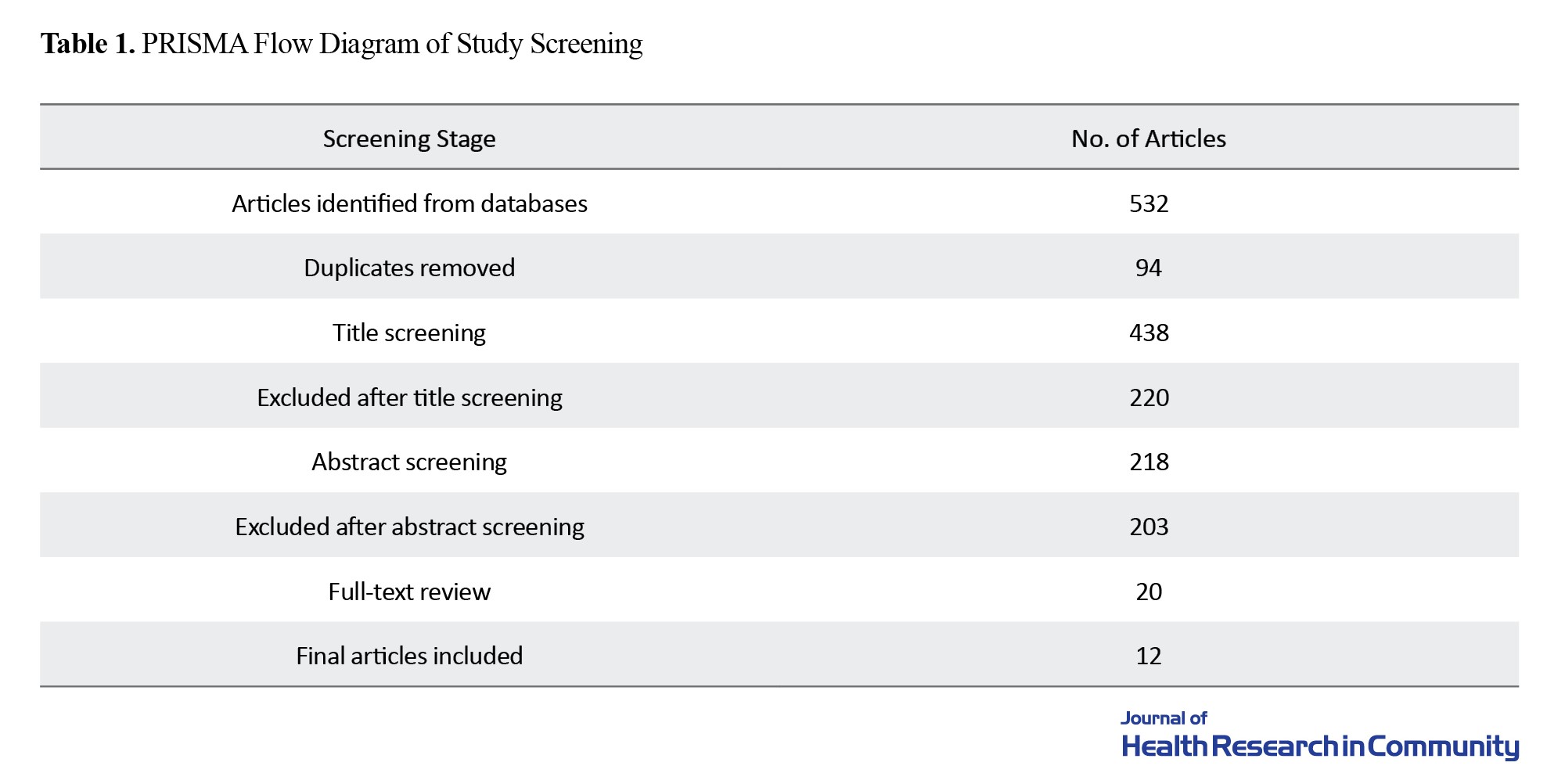
Of the initial 532 articles, 12 interventional studies (9 from Iran [13-23], 1 from the USA [27], 1 from Australia [24], and 1 from Nepal [28]) were included in the analysis. Publication years ranged from 2010 to 2025, with the highest concentration occurring between 2013 and 2015 (Table 1).
All studies utilized interventional designs with control groups (quasi-experimental or randomized controlled trials), and sample sizes ranged from 88 to 378 (mean ≈200). The target population primarily consisted of elementary and middle/high school students aged 10–16 years, with most falling within the 12–14 years range.
Interventions were multifaceted, including lectures, discussions, videos, booklets, PowerPoint presentations, and role-playing, along with implementation intentions. Five studies incorporated parent/teacher sessions [17, 18, 22, 29, 30]. Assessments were conducted using validated self-report TPB questionnaires, administered both before and 1–4 months after the intervention.
Based on the results, attitudes increased significantly in 10 studies [17–20, 22, 29–31] , Perceived behavioral control improved in 10 studies [17–20, 22, 29–31], and subjective norms increased in 7 studies [17, 19, 20, 22, 30, 31], with no significant change observed in 4 studies [18, 27, 29]. A significant relationship for intention was found in 11 studies [17–20, 22, 27, 29–31]. Breakfast consumption behavior improved in 10 studies [17–20, 22, 27, 29–31], while the consumption of unhealthy snacks/beverages decreased in 2 studies [17, 18]. One study showed that TPB constructs explained 39.3% of the variance in intention [24].
Conclusion
This systematic review demonstrates the substantial effectiveness of TPB-based educational interventions in improving breakfast consumption and related dietary habits among children and adolescents. Consistent with TPB, attitude and perceived behavioral control showed significant improvements in 10 out of 12 studies, emerging as key drivers of behavioral intention and actual breakfast-eating behavior [12, 17–20, 22, 29–31].
Subjective norm effects were inconsistent, being significant in only 7 studies [17, 19, 20, 22, 30, 31]. This inconsistency might be due to cultural or family differences, or limited family involvement [45]. Interventions that included parent/teacher sessions reinforced norms and sustainability [39, 40]. Strengths of the reviewed studies include multifaceted designs and family-centered elements [41–44].
Despite the geographic concentration on Iran (75%) and limitations such as short-term follow-up, the use of self-reported tools, and limited sample sizes in some studies, the results align with the TPB framework and confirm the theory’s utility in designing dietary behavior change programs.
It is recommended that future programs be designed as multilevel interventions (individual, family, and school) incorporating multiple sessions, the integration of modern technologies, and long-term follow-up. Future studies should examine moderating factors (age, gender, and socioeconomic status), and include comparisons with complementary theories to enhance intervention effectiveness and generalizability.
Ethical Considerations
Compliance with ethical guidelines
This study has been approved by Mazandaran University of Medical Sciences (Code: IR.MAZUMS.REC.1404.391).
Funding
This study was extracted from a Master’s thesis and supported by the Vice-Chancellor for Research and Technology, Mazandaran University of Medical Sciences (Grand No.: 22895).
Authors contributions
All authors contributed equally to this work.
Conflicts of interest
The authors declared no conflicts of interest.
References
Nutrition in childhood and adolescence is essential for physical and mental health, growth, and optimal development [1]. Breakfast, as a key daily meal, supplies energy, improves cognitive function and academic performance, reduces risky behaviors, and supports mental health [2, 3]. Despite its importance, skipping breakfast is common worldwide (10–30% in various studies) [4–6] and in Iran (e.g., 2.4% of students reported no breakfast in the past month) [7]. Contributing factors include busy family lifestyles, nutritional misconceptions, low parental awareness, socioeconomic status, maternal employment, and negative attitudes [8, 9].
The Theory of Planned Behavior (TPB) explains behavior through attitude (evaluation of outcomes), subjective norms (social pressure from important others), and perceived behavioral control (ease/difficulty based on resources/barriers) [12]. These form intention, the strongest predictor of behavior, with control also directly affecting it. TPB has proven effective in nutrition, physical activity, and other health behaviors [13–16]. Individual studies conducted in Iran and other parts of the word have shown that TPB-based interventions improve breakfast consumption [17–21, 24, 27–31]. However, no systematic review has specifically assessed TPB-based educational interventions for breakfast in children/adolescents. This review addressed this gap to guide school-based programs.
Methods
This systematic review was conducted according to the PRISMA guidelines. A structured search was performed in PubMed, Scopus, Web of Science, Google Scholar, Scientific Information Database (SID), and Magiran databases for English and Persian articles published between 2000 and 2025. Main keywords included “Theory of Planned Behavior,” “Educational Interventions,” “Breakfast Consumption,” “Children,” and “Adolescents,” combined using AND/OR operators. Inclusion criteria comprised interventional educational studies based on TPB aimed at improving breakfast consumption in children and adolescents with full-text access. Exclusion criteria included a focus on other meals, the use of non-TPB theories, or a lack of educational intervention. After removing duplicates, title/abstract screening and full-text review were conducted independently by two researchers. Study quality was assessed using the JBI checklist for randomized controlled trials (score ≥7 out of 13). Extracted data included study characteristics, interventions, TPB constructs, and outcomes.
Results
Of the initial 532 articles, 12 interventional studies (9 from Iran [13-23], 1 from the USA [27], 1 from Australia [24], and 1 from Nepal [28]) were included in the analysis. Publication years ranged from 2010 to 2025, with the highest concentration occurring between 2013 and 2015 (Table 1).
All studies utilized interventional designs with control groups (quasi-experimental or randomized controlled trials), and sample sizes ranged from 88 to 378 (mean ≈200). The target population primarily consisted of elementary and middle/high school students aged 10–16 years, with most falling within the 12–14 years range.
Interventions were multifaceted, including lectures, discussions, videos, booklets, PowerPoint presentations, and role-playing, along with implementation intentions. Five studies incorporated parent/teacher sessions [17, 18, 22, 29, 30]. Assessments were conducted using validated self-report TPB questionnaires, administered both before and 1–4 months after the intervention.
Based on the results, attitudes increased significantly in 10 studies [17–20, 22, 29–31] , Perceived behavioral control improved in 10 studies [17–20, 22, 29–31], and subjective norms increased in 7 studies [17, 19, 20, 22, 30, 31], with no significant change observed in 4 studies [18, 27, 29]. A significant relationship for intention was found in 11 studies [17–20, 22, 27, 29–31]. Breakfast consumption behavior improved in 10 studies [17–20, 22, 27, 29–31], while the consumption of unhealthy snacks/beverages decreased in 2 studies [17, 18]. One study showed that TPB constructs explained 39.3% of the variance in intention [24].
Conclusion
This systematic review demonstrates the substantial effectiveness of TPB-based educational interventions in improving breakfast consumption and related dietary habits among children and adolescents. Consistent with TPB, attitude and perceived behavioral control showed significant improvements in 10 out of 12 studies, emerging as key drivers of behavioral intention and actual breakfast-eating behavior [12, 17–20, 22, 29–31].
Subjective norm effects were inconsistent, being significant in only 7 studies [17, 19, 20, 22, 30, 31]. This inconsistency might be due to cultural or family differences, or limited family involvement [45]. Interventions that included parent/teacher sessions reinforced norms and sustainability [39, 40]. Strengths of the reviewed studies include multifaceted designs and family-centered elements [41–44].
Despite the geographic concentration on Iran (75%) and limitations such as short-term follow-up, the use of self-reported tools, and limited sample sizes in some studies, the results align with the TPB framework and confirm the theory’s utility in designing dietary behavior change programs.
It is recommended that future programs be designed as multilevel interventions (individual, family, and school) incorporating multiple sessions, the integration of modern technologies, and long-term follow-up. Future studies should examine moderating factors (age, gender, and socioeconomic status), and include comparisons with complementary theories to enhance intervention effectiveness and generalizability.
Ethical Considerations
Compliance with ethical guidelines
This study has been approved by Mazandaran University of Medical Sciences (Code: IR.MAZUMS.REC.1404.391).
Funding
This study was extracted from a Master’s thesis and supported by the Vice-Chancellor for Research and Technology, Mazandaran University of Medical Sciences (Grand No.: 22895).
Authors contributions
All authors contributed equally to this work.
Conflicts of interest
The authors declared no conflicts of interest.
References
- DiGirolamo AM, Ochaeta L, Flores RMM. Early childhood nutrition and cognitive functioning in childhood and adolescence. Food Nutr Bull. 2020; 41(1_suppl):S31-40 [DOI:10.1177/0379572120907763] [PMID]
- Polonsky HM, Bauer KW, Fisher JO, Davey A, Sherman S, Abel ML, et al. Effect of a breakfast in the classroom initiative on obesity in urban school-aged children: A cluster randomized clinical trial. JAMA Pediatr. 2019; 173(4):326-33 [DOI:10.1001/jamapediatrics.2018.5531] [PMID]
- Szajewska H, Ruszczyński M. Systematic review demonstrating that breakfast consumption influences body weight outcomes in children and adolescents in Europe. Crit Rev Food Sci Nutr. 2010; 50(2):113-9 [DOI:10.1080/10408390903467514] [PMID]
- Soheili Azad A, Nourjah N, Norouzi F. Survey the eating pattern between elementary students in Langrood. J Guilan Univ Med Sci. 2007; 16(62):36-41. [Link]
- Yaguchi-Tanaka Y, Tabuchi T. Skipping breakfast and subsequent overweight/obesity in children: A nationwide prospective study of 2.5-to 13-year-old children in Japan. J Epidemiol. 2021; 31(7):417-25 [DOI:10.2188/jea.JE20200266] [PMID]
- Ghafari M, Doosti-Irani A, Amiri M, Cheraghi Z. Prevalence of the Skipping Breakfast among the Iranian Students: A Review Article. Iran J Public Health. 2017; 46(7):882-9. [PMID]
- Gc R. Breakfast habits, nutritional status, body weight, and academic performance in children and adolescents. J Am Diet Assoc. 2005; 105:743-61. [DOI:10.1016/j.jada.2005.02.007] [PMID]
- Vereecken C, Dupuy M, Rasmussen M, Kelly C, Nansel TR, Al Sabbah H, et al. Breakfast consumption and its socio-demographic and lifestyle correlates in schoolchildren in 41 countries participating in the HBSC study. Int J Public Health. 2009; 54:180-90. [DOI:10.1007/s00038-009-5409-5] [PMID]
- Hazavehei S, Sharifirad G, Kargar M. The Comparison of Educational Intervention Effect Using BASNEF and Classic Models on Improving Assertion Skill Level. J Res Health Sci. 2008; 8(1):1-11. [PMID]
- Plotnikoff RC, Trinh L, Courneya KS, Karunamuni N, Sigal RJ. Predictors of aerobic physical activity and resistance training among Canadian adults with type 2 diabetes: An application of the Protection Motivation Theory. Psychol Sport Exerc. 2009; 10(3):320-8. [DOI:10.1016/j.psychsport.2008.10.002]
- Ajzen I. The theory of planned behavior. Organ Behav HumDecis Processes. 1991; 50(2):179-211. [DOI:10.1016/0749-5978(91)90020-T]
- Ashrafi E, Mansourian M, Azar FEF, Rahideh ST, Ezadi B, Osmani F. Investigation of factors related to healthy eating behavior based on the developed theory of planned behavior in adolescents. J Educ Health Promot. 2023; 12(1):274. [DOI:10.4103/jehp.jehp_904_22] [PMID]
- Bazargan-Hejazi S, Teruya S, Pan D, Lin J, Gordon D, Krochalk PC, et al. The theory of planned behavior (TPB) and texting while driving behavior in college students. Traffic Inj Prev. 2017; 18(1):56-62. [DOI:10.1080/15389588.2016.1172703] [PMID]
- Didarloo A, Sharafkhani N, Gharaaghaji R, Sheikhi S. Application of theory of planned behavior to improve obesity-preventive lifestyle among students: A school-based interventional study. Int J Pediatr. 2017; 5(11):6057-67. [Link]
- Taghdis MH, Babazadeh T, Moradi F, Shariat F. Effect of educational intervention on the fruit and vegetables consumption among the students: Applying theory of planned behavior. J Res Health Sci. 2016; 16(4):195-9. [PMID]
- Khani Jeihooni A, Jafarzadeh S, Kashfi SM, Rakhshani T, Afzali Harsini P. Effect of the Educational Program Based on the Planned Behaviour Theory on Breakfast Consumption of the High School Students. Health Educ Health Promot. 2025; 9(1):41-7. [Link]
- Gheysvandi E, Ardebili HE, Azam K, Vafa M, Azadbakht M, Babazadeh T, et al. [Effect of an educational intervention based on the theory of planned behavior on milk and dairy products consumption by girl-pupils (Persian)]. J Sch Public Health Inst Public Health Res. 2015; 13(2):45-54. [Link]
- Zendehtalab HR. The effect of intervention based on the theory of planned behavior on improving nutritional behaviors of students. J Res Health. 2014; 4(4):903-10. [Link]
- Gebremariam MK, Henjum S, Hurum E, Utne J, Terragni L, Torheim LE. Mediators of the association between parental education and breakfast consumption among adolescents: The ESSENS study. BMC Pediatr. 2017; 17(1):61.10.1186/s12887-017-0811-2 [DOI:10.1186/s12887-017-0811-2] [PMID]
- Lu Y. Impacts of parental breakfast consumption literacy on children’s home breakfast consumption. Nutr Health. 2023; 02601060231159943. [DOI:10.1177/02601060231159943] [PMID]
- Carson DE, Sharkey JR, McIntosh WA, Kubena KS, Goodson P. Predicting intention to eat breakfast among adolescents using the theory of planned behavior. FASEB J. 2010; 24:211.4-.4 [DOI:10.1096/fasebj.24.1_supplement.211.4]
- Kothe EJ, Mullan BA, Amaratunga R. Randomised controlled trial of a brief theory-based intervention promoting breakfast consumption. Appetite. 2011; 56(1):148-55. [DOI:10.1016/j.appet.2010.12.002] [PMID]
- Bhandari P, Adhikari S, Bhandari P, Adhikari S, Adhikari C. Multi-strategy instructional intervention for healthy eating intention among school going adolescents: A quasi-experimental study. BMC Nutr. 2025; 11(1):1-10 [DOI:10.1186/s40795-025-01105-2] [PMID]
- Gharlipour Z, Ghaffari M, Hoseini Z, Heidarabadi AB, Tavassoli E, Hozuri M, et al. Investigation of educational intervention based on Theory of Planned Behavior on breakfast consumption among middle school students of Qom City in 2012. J Educ Health Promot. 2015; 4(1):39 [DOI:10.4103/2277-9531.157224] [PMID]
- Gholipour-Baboli A, Toranjinejad A, Gilasi HR, Moravejy SA, Gharlipour Z, Ramezani T. Effect of educational program on milk consumption based on the theory of planned behavior among girl students. J Pediatr Perspect. 2017; 5(4):4793-802. [DOI:10.22038/ijp.2016.7707]
- Mohammadimanesh A, Rakhshani F, Eivazi R, Farhadian M. Effectiveness of educational intervention based on theory of planned behavior for increasing breakfast consumption among high school students in Hamadan. J Educ Community Health. 2015; 2(2):56-65. [Link]
- Barzegar F. [Evaluation of the effectiveness of an educational intervention based on the theory of planned behavior on breakfast consumption among fourth, fifth, and sixth grade students in Abarkuh County, Yazd (Persian)]. [MA thesis]. Yazd: Shahid Sadoughi University of Medical Sciences; 2018.
- Hosseini Z, Aghamolaei T, Gharlipour Gharghani Z, Ghanbarnejad A. Effect of educational interventions based on theory of planned behavior to promote breakfast consumption behavior in students. Hormozgan Med J. 2015; 19(1):31-9. [Link]
- Mohammadi Zeydi I, Pakpour-Hagiagha A. Application of the theory of planned behavior for the prevention of substance abuse among male adolescents. Iran J Health Educ Health Promot. 2016; 3(4):298-310. [Link]
- Mohammadi Zeidi I, Pakpour A. Effectiveness of an educational intervention based on theory of planned behavior to reduce intentions to smoke among secondary school students. J Res Health. 2013; 3(4):504 -13. [Link]
- Darabi F, Motamed S, Hosseini F, Neyshaboury AE. Nutrition education and students’ eating behaviors: An experimental study in Iran. BMC Public Health. 2025; 25(1):2039. [DOI:10.1186/s12889-025-23257-3] [PMID]
- Berg C, Jonsson I, Conner M. Understanding choice of milk and bread for breakfast among Swedish children aged 11-15 years: An application of the theory of planned behaviour. Appetite. 2000; 34(1):5-19. [DOI:10.1006/appe.1999.0269] [PMID]
- Conner M, Hugh-Jones S, Berg C. Using the two-factor Theory of Planned Behaviour to predict adolescent breakfast choices. Educ Child Psychol. 2011; 28(4):37.[DOI:10.53841/bpsecp.2011.28.4.37]
- Kennedy S, Davies E, Ryan L, Clegg M. Applying an extended theory of planned behaviour to predict breakfast consumption in adolescents. Eur J Clin Nutr. 2017; 71(5):607-13 [DOI:10.1038/ejcn.2016.192] [PMID]
- Mullan B, Wong C, Kothe E, Maccann C. Predicting breakfast consumption: A comparison of the theory of planned behaviour and the health action process approach. Br Food J. 2013; 115(11):1638-57. [DOI:10.1108/BFJ-05-2011-0127]
- Wong CL, Mullan BA. Predicting breakfast consumption: An application of the theory of planned behaviour and the investigation of past behaviour and executive function. Br J Health Psychol. 2009; 14(3):489-504. [DOI:10.1348/135910708X360719] [PMID]
- Bandura A. Health promotion by social cognitive means. Health Educ Behav. 2004; 31(2):143-64.[DOI:10.1177/1090198104263660] [PMID]
- Shakerinejad G, Dehghani SL, Zolghadr R, Baboli Z, Nejadsadeghi E. Effectiveness of a social cognitive theory and family system theory-based intervention in improving eating behaviors in preschool children. Ital J Pediatr. 2025; 51(1):125. [DOI:10.1186/s13052-025-01967-z] [PMID]
- Atashzadeh_Shoorideh H, Arshi S, Atashzadeh_Shoorideh F. The effect of family-centered empowerment model on the life style, self-efficacy and HbA1C of Diabetic Patients. Iran J Endocrinol Metab. 2017; 19(4):244-51. [Link]
- Rajabi R, Forozy M, Fuladvandi M, Eslami H, Asadabady A. The effect of family-centered empowerment model on the knowledge, attitudes and self-efficacy of mothers of children with asthma. J Nurs Educ. 2016; 5(4):41-50. [DOI:10.21859/jne-05046]
- Seyed Nematollah Roshan FA, Navipor H, Alhani F. [The effect of family centered empowerment model on quality of life in adolescent girls with iron deficiency anemia (Persian)]. Yafte. 2015; 16(4):88-99. [Link]
- Shakerian S, Amini H. The Effect of Education Based on the Family-oriented Empowerment Model on Self-care Behaviors of Patients with Type 2 Diabetes Referred to Rural Health Centers in Neka. J Health Res Community. 2019; 5(2):11-8. [Link]
- Heerman WJ, JaKa MM, Berge JM, Trapl ES, Sommer EC, Samuels LR, et al. The dose of behavioral interventions to prevent and treat childhood obesity: A systematic review and meta-regression. Int J Behav Nutr Phys Act. 2017; 14(1):157. [DOI:10.1186/s12966-017-0615-7] [PMID]
- Reid AE, Cialdini RB, Aiken LS. Social norms and health behavior. In: Steptoe A, editor. Handbook of behavioral medicine. New York: Springer; 2010. [DOI:10.1007/978-0-387-09488-5_19]
- Emanuel AS, McCully SN, Gallagher KM, Updegraff JA. Theory of Planned Behavior explains gender difference in fruit and vegetable consumption. Appetite. 2012; 59(3):693-7. [DOI:10.1016/j.appet.2012.08.007] [PMID]
- Deci EL, Ryan RM. Self-determination theory. In: Van Lange PAM, Kruglanski AW, Tory Higgins E, editors. Handbook of theories of social psychology. Atlanta: SAGE; 2012. [Link]
Type of Study: Review |
Subject:
Health Education and Promotion
Send email to the article author
| Rights and permissions | |
 |
This work is licensed under a Creative Commons Attribution-NonCommercial 4.0 International License. |
