

Volume 11, Issue 3 (Autumn 2025)
J Health Res Commun 2025, 11(3): 50-63 |
Back to browse issues page


Download citation:
BibTeX | RIS | EndNote | Medlars | ProCite | Reference Manager | RefWorks
Send citation to:


BibTeX | RIS | EndNote | Medlars | ProCite | Reference Manager | RefWorks
Send citation to:
Davoudi H, Shams Kolahi S. Impact of Compassion-focused Therapy on the Self-compassion of Mothers of Children With Autism Spectrum Disorder in Iran. J Health Res Commun 2025; 11 (3) :50-63
URL: http://jhc.mazums.ac.ir/article-1-1166-en.html
URL: http://jhc.mazums.ac.ir/article-1-1166-en.html


Department of Counseling, Khom.C. , Islamic Azad University, Khomein, Iran.
Full-Text [PDF 6794 kb]
(400 Downloads)
| Abstract (HTML) (1300 Views)
References
Full-Text: (114 Views)
Introduction
One of the most stressful experiences in any family is having a child with disability or chronic illness such as Autism Spectrum Disorder (ASD). ASD is usually diagnosed at the age of 2-5 years. Over the past few decades, the prevalence of ASD has increased, affecting 1 in 68 school-age children. Parents of these children report social interaction problems and stereotypical behaviors in their children. The parents’ feeling of inability to control their child’s inappropriate behaviors can increase the intensity of their stress. Given the high prevalence of stress, anxiety, and self-criticism in mothers of children with ASD, it seems that interventions that focus on increasing self-compassion and reducing self-judgment, such as compassion-focused therapy (CFT), can be helpful. Studies have shown that self-compassion is a powerful predictor of mental health. Also, self-compassion is negatively related to self-criticism, depression, anxiety, rumination, and thought suppression. Therefore, the present study aimed to investigate the effectiveness of CFT in improving the level of self-compassion in mothers of children with ASD in Iran. The main hypothesis of the research is: CFT is effective in improving self-compassion in mothers of children with ASD.
Materials & Methods
This is a quasi-experimental study with a pre-test-posttest design. The study population consisted of all mothers of children with ASD living in Arak, Iran, in 2024. Using a non-random, convenience, and purposive sampling methods, 40 eligible mothers were selected and randomly assigned to two groups of CFT and control (each with 20 people). The instrument used in this study was the self-compassion scale (SCS) developed by Neff et al. (2003). In this study, the long form of this scale was used (having 26 items). The questionnaire’s overall reliability, as measured by Cronbach’s alpha in the present study, was 0.88. The participants who scored 30-70 on this questionnaire were included. The cut-off point of this questionnaire is 65. The intervention group received an educational intervention based on Germer’s protocol. This intervention was implemented in 7 weekly two-hour group sessions. During the training sessions, the control group did not receive any type of intervention. To test the research hypotheses, one-way analysis of covariance was used. It should be noted that all assumptions for using analysis of covariance were met.
Results
The results show that the mean total score of the SCS in the pre-test phase was 82.50±6.57 in the CFT group and 80.70±7.72 in the control group. In the post-test phase, the scores changed to 92.30±6.32 and 80.40±8.07, respectively.
The results in Table 1 showed that CFT had a significant effect on the self-compassion of mothers (F1,17=56.98, η2=0.77, P<0.001).
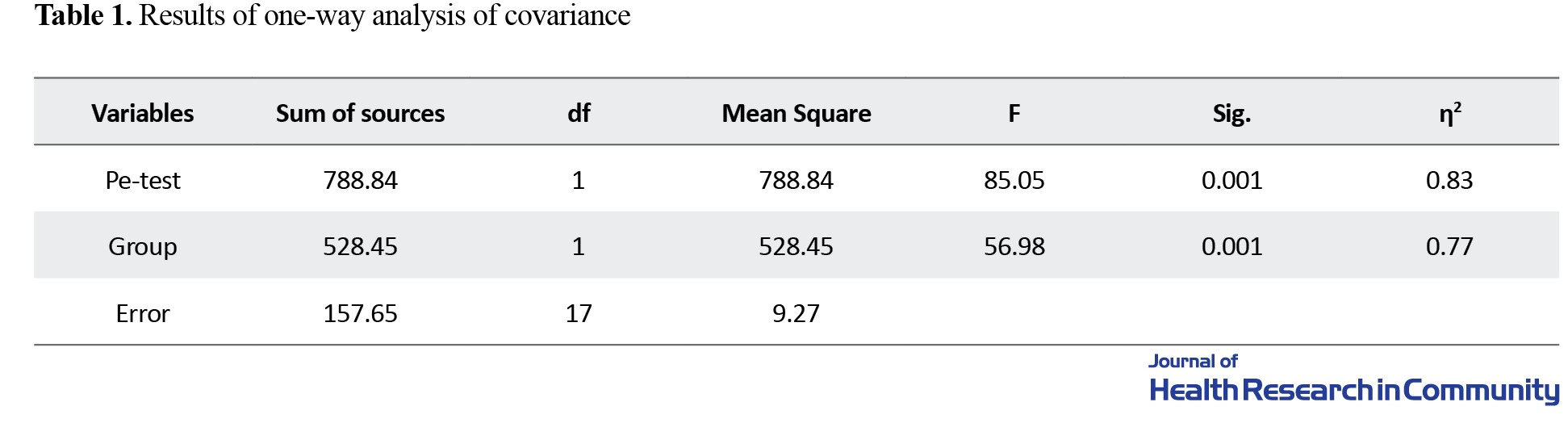
The value of the eta coefficient shows that the training explained 77% of the variance in the self-compassion of mothers. To determine the effectiveness of CFT on the six components of self-compassion, the results showed that CFT had a significant effect on all components including self-kindness (F1.12=9.67, P=0.001, η2=0.44), self-judgment (F1.12=18.96, P=0.001, η2=0.61), common humanity (F1.12=4.46, P=0.05, η2=0.27), isolation (F1.12=22.62, P=0.001, η2=0.65), mindfulness (F1.12=7.83, P=0.01, η2=0.39), and over-identification (F1.12=5.37, P=0.03, η2=0.31). The greatest effectiveness of CFT was on the isolation subscale and had the least effect on human commonalities.
Conclusion
The results showed that CFT was effective in improving the self-compassion of mothers of children with ASD. Among the components of self-compassion, CFT had the greatest impact on the “isolation” and “self-judgment” of mothers. Increasing self-compassion can be the key to effective knowledge and action mechanisms for parents of children with autism and reduce their stress, because self-compassion reveals limitations and identifies unhealthy behaviors and improves them through follow-up. The limitations of the present study included the use of convenience sampling, reliance solely on self-report data, and the lack of a follow-up phase. Given the importance of self-compassion and the results of the current study, it is recommended that this intervention be used as a complementary program in treatment clinics, rehabilitation centers, and support groups for families with autistic children.
Ethical Considerations
Compliance with ethical guidelines
This study was approved by the Ethics Committee of Islamic Azad University, Khomein Branch (Code: IR.IAU.ARAK.REC.1403.247).
Funding
This article was extracted from the thesis of Sahar Shams Kolahi at Islamic Azad University, Khomein Branch. This research did not receive any specific grant from funding agencies in the public, commercial, or not-for profit sectors.
Authors contributions
All authors contributed to conceptualization, literature review, methodology, data analysis and interpretation of data. The second author performed pre-test and post-test assessments and wrote the initial draft.
Conflicts of interest
The authors declare no conflict of interest.
Acknowledgments
The authors would like to thank the officials and staff of the Arak Autism Association, as well as all participants in this study, for their assistance and cooperation.
One of the most stressful experiences in any family is having a child with disability or chronic illness such as Autism Spectrum Disorder (ASD). ASD is usually diagnosed at the age of 2-5 years. Over the past few decades, the prevalence of ASD has increased, affecting 1 in 68 school-age children. Parents of these children report social interaction problems and stereotypical behaviors in their children. The parents’ feeling of inability to control their child’s inappropriate behaviors can increase the intensity of their stress. Given the high prevalence of stress, anxiety, and self-criticism in mothers of children with ASD, it seems that interventions that focus on increasing self-compassion and reducing self-judgment, such as compassion-focused therapy (CFT), can be helpful. Studies have shown that self-compassion is a powerful predictor of mental health. Also, self-compassion is negatively related to self-criticism, depression, anxiety, rumination, and thought suppression. Therefore, the present study aimed to investigate the effectiveness of CFT in improving the level of self-compassion in mothers of children with ASD in Iran. The main hypothesis of the research is: CFT is effective in improving self-compassion in mothers of children with ASD.
Materials & Methods
This is a quasi-experimental study with a pre-test-posttest design. The study population consisted of all mothers of children with ASD living in Arak, Iran, in 2024. Using a non-random, convenience, and purposive sampling methods, 40 eligible mothers were selected and randomly assigned to two groups of CFT and control (each with 20 people). The instrument used in this study was the self-compassion scale (SCS) developed by Neff et al. (2003). In this study, the long form of this scale was used (having 26 items). The questionnaire’s overall reliability, as measured by Cronbach’s alpha in the present study, was 0.88. The participants who scored 30-70 on this questionnaire were included. The cut-off point of this questionnaire is 65. The intervention group received an educational intervention based on Germer’s protocol. This intervention was implemented in 7 weekly two-hour group sessions. During the training sessions, the control group did not receive any type of intervention. To test the research hypotheses, one-way analysis of covariance was used. It should be noted that all assumptions for using analysis of covariance were met.
Results
The results show that the mean total score of the SCS in the pre-test phase was 82.50±6.57 in the CFT group and 80.70±7.72 in the control group. In the post-test phase, the scores changed to 92.30±6.32 and 80.40±8.07, respectively.
The results in Table 1 showed that CFT had a significant effect on the self-compassion of mothers (F1,17=56.98, η2=0.77, P<0.001).
The value of the eta coefficient shows that the training explained 77% of the variance in the self-compassion of mothers. To determine the effectiveness of CFT on the six components of self-compassion, the results showed that CFT had a significant effect on all components including self-kindness (F1.12=9.67, P=0.001, η2=0.44), self-judgment (F1.12=18.96, P=0.001, η2=0.61), common humanity (F1.12=4.46, P=0.05, η2=0.27), isolation (F1.12=22.62, P=0.001, η2=0.65), mindfulness (F1.12=7.83, P=0.01, η2=0.39), and over-identification (F1.12=5.37, P=0.03, η2=0.31). The greatest effectiveness of CFT was on the isolation subscale and had the least effect on human commonalities.
Conclusion
The results showed that CFT was effective in improving the self-compassion of mothers of children with ASD. Among the components of self-compassion, CFT had the greatest impact on the “isolation” and “self-judgment” of mothers. Increasing self-compassion can be the key to effective knowledge and action mechanisms for parents of children with autism and reduce their stress, because self-compassion reveals limitations and identifies unhealthy behaviors and improves them through follow-up. The limitations of the present study included the use of convenience sampling, reliance solely on self-report data, and the lack of a follow-up phase. Given the importance of self-compassion and the results of the current study, it is recommended that this intervention be used as a complementary program in treatment clinics, rehabilitation centers, and support groups for families with autistic children.
Ethical Considerations
Compliance with ethical guidelines
This study was approved by the Ethics Committee of Islamic Azad University, Khomein Branch (Code: IR.IAU.ARAK.REC.1403.247).
Funding
This article was extracted from the thesis of Sahar Shams Kolahi at Islamic Azad University, Khomein Branch. This research did not receive any specific grant from funding agencies in the public, commercial, or not-for profit sectors.
Authors contributions
All authors contributed to conceptualization, literature review, methodology, data analysis and interpretation of data. The second author performed pre-test and post-test assessments and wrote the initial draft.
Conflicts of interest
The authors declare no conflict of interest.
Acknowledgments
The authors would like to thank the officials and staff of the Arak Autism Association, as well as all participants in this study, for their assistance and cooperation.
References
- Dalton L, Rapa E, Stein A. Protecting the psychological health of children through effective communication about COVID-19. Lancet Child Adolesc Health. 2020; 4(5):346-7. [DOI:10.1016/S2352-4642(20)30097-3] [PMID]
- Kober R. The effect of employment on the quality of life of people with intellectual disabilities: A review of the literature. In: Kober R, editor. Enhancing the quality of life of people with intellectual disabilities. New York: Springer; 2020. [DOI:10.1007/978-90-481-9650-0_7]
- Soltani Nejad S, Kashi A, Zarezadeh M, Ghasemi A. [Musical-motor activities on autism symptoms in children with high-functioning autism spectrum disorder (Persian)]. J Disabil Stud. 2020; 10(1):68. [Link]
- Bohadana G, Morrissey S, Paynter J. Self-compassion: A novel predictor of stress and quality of life in parents of children with autism spectrum disorder. J Autism Dev Disord. 2019; 49(10):4039-52. [DOI:10.1007/s10803-019-04121-x] [PMID]
- American Psychiatric Association. Diagnostic and statistical manual of mental disorders (5th ed). Washington: American Psychological Association; 2013. [DOI:10.1176/appi.books.9780890425596]
- Ahmadi Kahjoogh M, Farahbod M, Soortigi H, Rassafiani M. [Sensory processing patterns in children with autism disorder from Winnie Dunn’s perspective (Persian)]. J Except Child. 2011; 10(4):385-93. [Link]
- Hosein Abadi S, Pourshahryari M, Zandipour T. [Effectiveness of positive psychology on psychological well-being of mothers of autistic children (Persian)]. Empowering Except Child. 2017; 8(1):54-60. [Link]
- Inal-Kaleli I, Dogan N, Kose S, Bora E. Investigating the presence of autistic traits and prevalence of autism spectrum disorder symptoms in anorexia nervosa: A systematic review and meta-analysis. Int J Eat Disord. 2025; 58(1):66-90. [DOI:10.1002/eat.24307] [PMID]
- Maenner MJ, Warren Z, Williams AR, Amoakohene E, Bakian AV, Bilder DA, et al. Prevalence and characteristics of autism spectrum disorder among children aged 8 years-Autism and developmental disabilities monitoring network, 11 sites, United States, 2020. MMWR Surveill Summ. 2023; 72(2):1-14. [DOI:10.15585/mmwr.ss7202a1] [PMID]
- Yavari A, Zamanian M, Panahian M, Valizadeh A. Prevalence of Autism Spectrum Disorder with High-Functioning among Children Aged 7-12 Years. Depiction of Health. 2022; 13(2):165-74. [DOI:10.34172/doh.2022.24]
- Vakilizadeh N, Abedi A, Mohseni Ezhiyeh A. [Investigating validity and reliability of early screening for autistic traits-Persian version (ESAT-PV) in toddlers (Persian)]. J Rehabil. 2017; 18(3):182-93. [DOI:10.21859/jrehab-1803182]
- Weiner DJ, Wigdor EM, Ripke S, Walters RK, Kosmicki JA, Grove J, et al. Polygenic transmission disequilibrium confirms that common and rare variation act additively to create risk for autism spectrum disorders. Nat Genet. 2017; 49(7):978-85. [DOI:10.1038/ng.3863] [PMID]
- Nayar K, Sealock JM, Maltman N, Bush L, Cook EH, Davis LK, et al. Elevated polygenic burden for autism spectrum disorder is associated with the broad autism phenotype in mothers of individuals with autism spectrum disorder. Biol Psychiatry. 2021; 89(5):476-85. [DOI:10.1016/j.biopsych.2020.08.029] [PMID]
- Sattari M, Ashrafi Alavije M, Jarrah E. [Predicting resilience and self-compassion based on cognitive flexibility in fathers of children with autism spectrum disorder (Persian)]. J Disabil Stud. 2022; 12:96-96. [Link]
- Kazemi N, Dadashloo F, Seyf FS. [Prediction of psychological well-being and resilience in mothers of children with autism spectrum disorder based on cognitive flexibility (Persian)]. JMiddle EastJ Disabil Stud. 2019; 9:12. [Link]
- Jose A, Gupta S, Gulati S, Sapra S. Prevalence of depression in mothers of children having ASD. Curr Med Res Pract. 2017; 7(1):11-5. [DOI:10.1016/j.cmrp.2016.12.003]
- Liang K, Lai Lam KK, Huang L, Lin X, Wang Z, Liu H, et al. Self-compassion, mental health, and parenting: Comparing parents of autistic and non-autistic children. Autism. 2025; 29(1):53-63. [DOI:10.1177/13623613241286683] [PMID]
- Afshani PD, Abou’ee A. [The effectiveness of self-compassion training in students’ anger control (Persian)]. J Fam Res. 2019; 16(3):103-24. [Link]
- Bohadana G, Morrissey S, Paynter J. Self-compassion in mothers of children with autism spectrum disorder: A qualitative analysis. J Autism Dev Disord. 2021; 51(4):1290-303. [DOI:10.1007/s10803-020-04612-2] [PMID]
- Neff KD. Setting the record straight about the self-compassion scale. Mindfulness, 2019, 10(1):200-2. [DOI:10.1007/s12671-018-1061-6]
- Voci A, Veneziani CA, Fuochi G. Relating mindfulness, heartfulness, and psychological well-being: The role of self-compassion and gratitude. Mindfulness. 2019; 10(2):339- 51. [DOI:10.1007/s12671-018-0978-0]
- Choo PY, Marszalek JM. Self-compassion: A potential shield against extreme self-reliance? J Happiness Stud. 2019; 20(3):971-94. [DOI:10.1007/s10902-018-9978-y]
- Neff KD, Dahm KA. Self-compassion: What it is, what it does, and how it relates to mindfulness. In: Ostafin BD, Robinson MD, Meier BP, editors. Handbook of mindfulness and self-regulation. New York: Springer; 2015 [DOI:10.1007/978-1-4939-2263-5_10]
- Kazemi A, Sharifi Fard A. [Comparison of self-compassion, resilient and psychological well-being in mothers with autism children and normal children (Persian)]. J Psychol N Ideas. 2021; 8(12):1-4. [Link]
- Nuri HR, Shahabi B. [The effectiveness of self-compassion training on increase of mothers resiliency with autistic children (Persian)]. Knowl Res Appl Psychol. 2017; 18(3):118-26. [Link]
- Bazzano A, Wolfe C, Zylowska L, Wang S, Schuster E, Barrett C, et al. Mindfulness based stress reduction (MBSR) for parents and caregivers of individuals with developmental disabilities: A community-based approach. J Child Fam Stud. 2015; 24(2):298-308. [DOI:10.1007/s10826-013-9836-9]
- Neff KD, Faso DJ. Self-compassion and well-being in parents of children with autism. Mindfulness, 2015; 6:938-47. [DOI:10.1007/s12671-014-0359-2]
- Brenjestanaki MR, Abbasi G, Mirzaian B. [Effectiveness of compassion-focused therapy on psychological flexibility recovery and self-criticism decrease in mothers with mentally retarded children (Persian)]. Biannual J Appl Couns. 2020; 10(1):1-8. [DOI:10.22055/jac.2020.33836.1749]
- Li SN, Chien WT, Lam SK, Chen ZY, Ma X. Effectiveness of parent-focused interventions for improving the mental health of parents and their children with autism spectrum disorder: A systematic review and meta-analysis. Res Autism Spectrum Disord. 2024; 114:102389. [DOI:10.1016/j.rasd.2024.102389]
- Bacherini A, Igliozzi R, Cagiano R, Mancini A, Tancredi R, Muratori F, et al. Behavioral and emotional problems of toddlers with autism spectrum disorder: Effects of parents' sociocultural level and individual factors. Res Dev Disabil. 2021; 119:104106. [DOI:10.1016/j.ridd.2021.104106] [PMID]
- Churchill SS, Leo MC, Brennan EM, Sellmaier C, Kendall J, Houck GM. Longitudinal impact of a randomized clinical trial to improve family function, reduce maternal stress and improve child outcomes in families of children with ADHD. Matern Child Health J. 2018; 22(8):1172-82. [DOI:10.1007/s10995-018-2502-5] [PMID]
- Khosravi S, Sadeghi M, Yabandeh MR. [Psychometric properties of self-compassion scale (SCS) (Persian)]. J Psychol Model Methods. 2013; 4(13):47-59. [Link]
- Khanjani S, Foroughi AA, Sadghi K, Bahrainian SA. [Psychometric properties of Iranian version of self-compassion scale (short form) (Persian)]. Pajoohandeh J. 2016; 21(5):282-9. [Link]
- Taheri A, Marashi S A, Hamid N, Beshlideh K. [The effectiveness of compassion-focused therapy on psychological well-being and meaning in life of mothers of children with intellectual and developmental disorders (Persian)]. Iran J Psychiatry Clin Psychol. 2022; 28(1):20-33. [DOI:10.32598/ijpcp.28.1.3046.1]
- Neff KD. Self-compassion, self-esteem, and well-being. Soc Personal Psychol Compass. 2011; 5(1):1-12. [DOI:10.1111/j.1751-9004.2010.00330.x]
- Tajdin Lirak A, Aleyasin SA, Heidari H, Davoodi H. Comparison of the effectiveness of compassion and reality therapy on the life expectancy of imprisoned men. Med J Mashhad Univ Med Sci. 2020; 63(1):2322-31. [DOI:10.22038/mjms.2020.22406]
Type of Study: Research(Original) |
Subject:
Health Education and Promotion
Send email to the article author
| Rights and permissions | |
 |
This work is licensed under a Creative Commons Attribution-NonCommercial 4.0 International License. |
