

Volume 11, Issue 3 (Autumn 2025)
J Health Res Commun 2025, 11(3): 96-103 |
Back to browse issues page



Download citation:
BibTeX | RIS | EndNote | Medlars | ProCite | Reference Manager | RefWorks
Send citation to:


BibTeX | RIS | EndNote | Medlars | ProCite | Reference Manager | RefWorks
Send citation to:
Abbasi E, Salavatizadeh M, Dast Shoste A. Epidemiologic and Clinical Characteristics of Children with Drowning Admitted to a Hospital in Urmia, Iran: A Ten-Year Study (2013–2023). J Health Res Commun 2025; 11 (3) :96-103
URL: http://jhc.mazums.ac.ir/article-1-1137-en.html
URL: http://jhc.mazums.ac.ir/article-1-1137-en.html


Department of Pediatric Diseases, Faculty of Medicine, Urmia University of Medical Sciences, Urmia, Iran.
Full-Text [PDF 2674 kb]
(350 Downloads)
| Abstract (HTML) (1267 Views)
Full-Text: (115 Views)
Introduction
Drowning is a major cause of unintentional injury-related mortality in children and represents a critical yet preventable global public health issue. Despite numerous international reports highlighting regional variations in risk factors, clinical manifestations, and outcomes, limited data are available from Iran, especially its northwest region, where natural water environments significantly contribute to drowning incidents among children. Understanding the local epidemiology and clinical predictors of mortality is crucial for establishing region-specific prevention strategies and improving early management protocols. This study aimed to investigate the epidemiologic patterns, accident characteristics, and clinical and laboratory parameters associated with outcomes in children hospitalized due to drowning in Urmia, Iran, over ten years (2013–2023). By identifying prognostic markers such as Glasgow coma scale (GCS), hypothermia, need for cardiopulmonary resuscitation (CPR), intubation, and metabolic disturbances, this research aims to provide evidence-based insights to guide clinicians, policymakers, and public health authorities in reducing drowning mortality and improving hospital care for pediatric drowning victims.
Methods
This retrospective cross-sectional study included all children under 18 years of age who were admitted due to drowning or near-drowning to Shahid Motahhari Hospital in Urmia from 2013 to 2023. A total of 89 medical records meeting the inclusion criteria were retrieved. Demographic information (age, sex); accident characteristics including place of accident (private pool, public pool, river, canal, well, & qanat); submersion duration (less or more than 10 minutes); time/season, occurrence in holidays/non-holidays; clinical information including GCS score, body temperature, presence of hypothermia (<35°C), the need for CPR, endotracheal intubation, inotrope administration, and admission to the pediatric intensive care unit (PICU); laboratory information, including blood glucose and blood pH. The main outcome variable was hospital mortality, categorized by survival and non-survival.
Data were entered into SPSS software, version 27. Descriptive statistics (frequency, percentage, mean, and standard deviation) were used to describe the data. Inferential statistics included Chi-square and Fisher’s exact tests for categorical variables and independent t-test or Mann–Whitney U test for continuous variables, depending on the normality of data distribution. P<0.05 was considered statistically significant.
Results
A total of 89 children were hospitalized due to drowning during the ten years, whose mean age was approximately 9 years. Of these, 61 (68.5%) were boys, and 28 (31.5%) were girls. Mortality occurred in 53 children (59.6%), including 33 boys (54.1%) and 20 girls (71.4%); although higher in girls, the sex difference was not statistically significant.
Most of the death cases due to drowning occurred in natural environments such as rivers, canals, wells, and qanats (n=46, 83.6%). In contrast, survival was much higher in pool-related drowning cases, with 78.9% survival in private pools and 80% survival in public pools. Most drowning accidents occurred on holidays (n=58, 65.2%) and in summer (n=45, 50.6%).
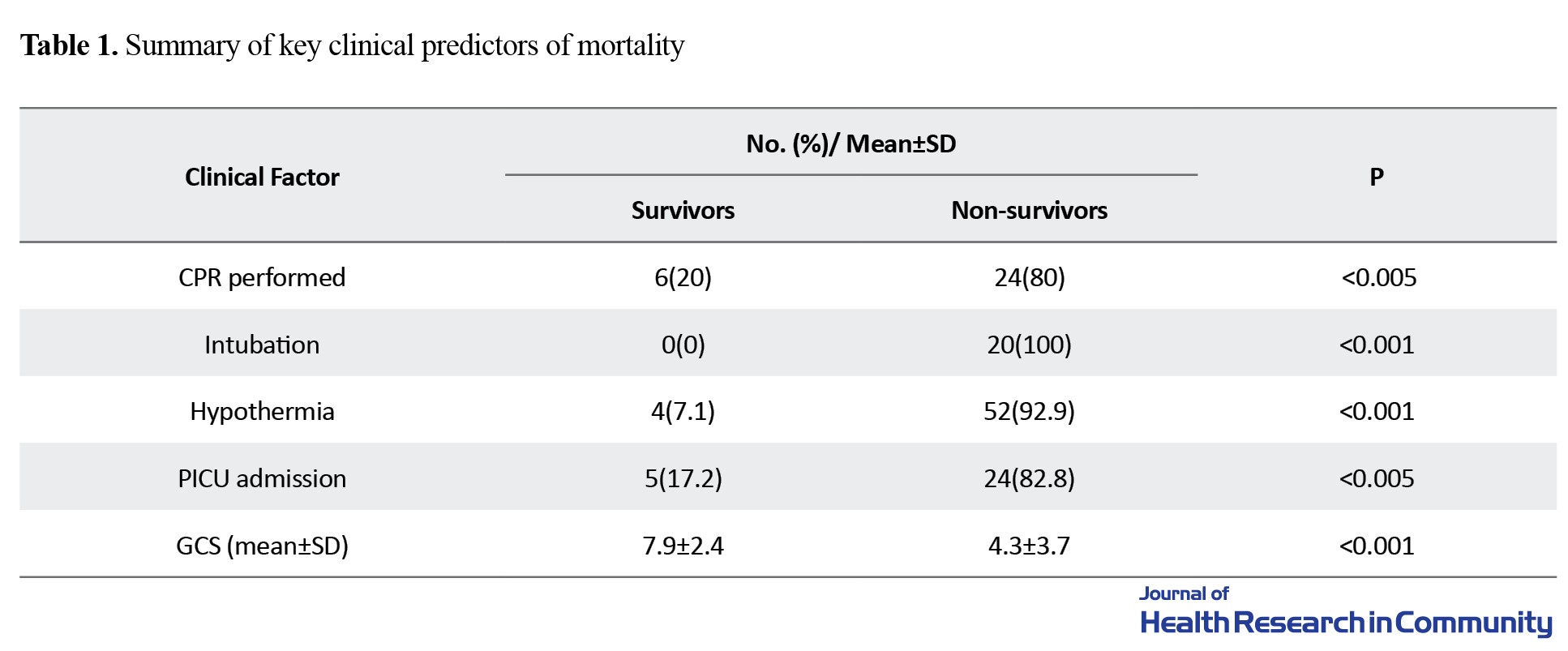
Thirty children required CPR, of whom 24 (80%) died. All 20 intubated patients (22.5%) and all 20 inotrope recipients (22.5%) died. PICU admission was required in 29 children; however, 24 (82.7%) died, reflecting the severity of their condition. Hypothermia was observed in 56 children (62.9%), of whom 52 (92.9%) died, indicating a strong association with mortality. Laboratory findings further demonstrated significant differences between survivors and non-survivors. Mean GCS score was considerably lower in non-survivors (4.3±3.7) than in survivors (7.9±2.4). Mean arterial pH was also lower in non-survivors (6.92±0.10) than in survivors (7.30±0.10).The mean blood glucose level was also significantly lower in the deceased group (82.1±20.1 vs. 134.9±18.8) (Table 1).
Conclusion
This ten-year analysis demonstrated the high mortality rate among pediatric drowning cases in northwest Iran, particularly in those occurred in natural water environments. Prolonged submersion, need for CPR, intubation, hypothermia, low GCS, and metabolic acidosis are risk factors. The highest mortality among intubated and inotrope-receiving children reflects severe hypoxic injury at the time of admission. The findings highlight the need for targeted preventive strategies in high-risk environments such as rivers and canals, where most deaths occurred. Community education programs, improved water-safety regulations, parental supervision, and widespread CPR training may substantially reduce mortality. Clinically, early identification of critical prognostic markers and rapid initiation of advanced life support are essential for improving survival.
Ethical Considerations
Compliance with ethical guidelines
This study was approved by the Ethics Committee of Urmia University of Medical Sciences (IR.UMSU.REC.1403.098). Patient confidentiality and data privacy were strictly observed.
Funding
This article was extracted from a thesis funded by Urmia University of Medical Sciences.
Authors contributions
Design, conceptualization, methodology, supervision, review & editing: Ezatollah Abbasi; Design, conceptualization, supervision, validation, writing the initial draft: Mohammad Salavatizadeh; Data extraction, analysis, visualization, investigation: Arash Dast Shoste.
Conflicts of interest
The authors declare no conflict of interest.
Acknowledgments
The authors would like to thank the Vice-Chancellor for Research and Technology of Urmia University of Medical Sciences, and the pediatric and PICU staff of Shahid Motahhari Hospital in Urmia for their cooperation.
References
Drowning is a major cause of unintentional injury-related mortality in children and represents a critical yet preventable global public health issue. Despite numerous international reports highlighting regional variations in risk factors, clinical manifestations, and outcomes, limited data are available from Iran, especially its northwest region, where natural water environments significantly contribute to drowning incidents among children. Understanding the local epidemiology and clinical predictors of mortality is crucial for establishing region-specific prevention strategies and improving early management protocols. This study aimed to investigate the epidemiologic patterns, accident characteristics, and clinical and laboratory parameters associated with outcomes in children hospitalized due to drowning in Urmia, Iran, over ten years (2013–2023). By identifying prognostic markers such as Glasgow coma scale (GCS), hypothermia, need for cardiopulmonary resuscitation (CPR), intubation, and metabolic disturbances, this research aims to provide evidence-based insights to guide clinicians, policymakers, and public health authorities in reducing drowning mortality and improving hospital care for pediatric drowning victims.
Methods
This retrospective cross-sectional study included all children under 18 years of age who were admitted due to drowning or near-drowning to Shahid Motahhari Hospital in Urmia from 2013 to 2023. A total of 89 medical records meeting the inclusion criteria were retrieved. Demographic information (age, sex); accident characteristics including place of accident (private pool, public pool, river, canal, well, & qanat); submersion duration (less or more than 10 minutes); time/season, occurrence in holidays/non-holidays; clinical information including GCS score, body temperature, presence of hypothermia (<35°C), the need for CPR, endotracheal intubation, inotrope administration, and admission to the pediatric intensive care unit (PICU); laboratory information, including blood glucose and blood pH. The main outcome variable was hospital mortality, categorized by survival and non-survival.
Data were entered into SPSS software, version 27. Descriptive statistics (frequency, percentage, mean, and standard deviation) were used to describe the data. Inferential statistics included Chi-square and Fisher’s exact tests for categorical variables and independent t-test or Mann–Whitney U test for continuous variables, depending on the normality of data distribution. P<0.05 was considered statistically significant.
Results
A total of 89 children were hospitalized due to drowning during the ten years, whose mean age was approximately 9 years. Of these, 61 (68.5%) were boys, and 28 (31.5%) were girls. Mortality occurred in 53 children (59.6%), including 33 boys (54.1%) and 20 girls (71.4%); although higher in girls, the sex difference was not statistically significant.
Most of the death cases due to drowning occurred in natural environments such as rivers, canals, wells, and qanats (n=46, 83.6%). In contrast, survival was much higher in pool-related drowning cases, with 78.9% survival in private pools and 80% survival in public pools. Most drowning accidents occurred on holidays (n=58, 65.2%) and in summer (n=45, 50.6%).
Thirty children required CPR, of whom 24 (80%) died. All 20 intubated patients (22.5%) and all 20 inotrope recipients (22.5%) died. PICU admission was required in 29 children; however, 24 (82.7%) died, reflecting the severity of their condition. Hypothermia was observed in 56 children (62.9%), of whom 52 (92.9%) died, indicating a strong association with mortality. Laboratory findings further demonstrated significant differences between survivors and non-survivors. Mean GCS score was considerably lower in non-survivors (4.3±3.7) than in survivors (7.9±2.4). Mean arterial pH was also lower in non-survivors (6.92±0.10) than in survivors (7.30±0.10).The mean blood glucose level was also significantly lower in the deceased group (82.1±20.1 vs. 134.9±18.8) (Table 1).
Conclusion
This ten-year analysis demonstrated the high mortality rate among pediatric drowning cases in northwest Iran, particularly in those occurred in natural water environments. Prolonged submersion, need for CPR, intubation, hypothermia, low GCS, and metabolic acidosis are risk factors. The highest mortality among intubated and inotrope-receiving children reflects severe hypoxic injury at the time of admission. The findings highlight the need for targeted preventive strategies in high-risk environments such as rivers and canals, where most deaths occurred. Community education programs, improved water-safety regulations, parental supervision, and widespread CPR training may substantially reduce mortality. Clinically, early identification of critical prognostic markers and rapid initiation of advanced life support are essential for improving survival.
Ethical Considerations
Compliance with ethical guidelines
This study was approved by the Ethics Committee of Urmia University of Medical Sciences (IR.UMSU.REC.1403.098). Patient confidentiality and data privacy were strictly observed.
Funding
This article was extracted from a thesis funded by Urmia University of Medical Sciences.
Authors contributions
Design, conceptualization, methodology, supervision, review & editing: Ezatollah Abbasi; Design, conceptualization, supervision, validation, writing the initial draft: Mohammad Salavatizadeh; Data extraction, analysis, visualization, investigation: Arash Dast Shoste.
Conflicts of interest
The authors declare no conflict of interest.
Acknowledgments
The authors would like to thank the Vice-Chancellor for Research and Technology of Urmia University of Medical Sciences, and the pediatric and PICU staff of Shahid Motahhari Hospital in Urmia for their cooperation.
References
- Duignan KM, Luu H, Delgado JH, London S, Ratzan RM. Drowning incidents precipitated by unusual causes (DIPUCs): A narrative review of their diagnoses, evaluation and management. Resusc Plus. 2024; 20:100770. [DOI:10.1016/j.resplu.2024.100770] [PMID]
- World Health Organization (WHO). Obesity and overweight [Internet]. 2023 [Updated 2025 December 8]. Available from: [Link]
- Shenoi RP, Crowe JE, Dorfman SR, Bergmann KR, Mistry RD, Hariharan S, et al. Factors associated with pediatric drowning-Associated lung injury. J Pediatr. 2025; 279:114459. [DOI:10.1016/j.jpeds.2024.114459] [PMID]
- Işın A, Peden AE. The burden, risk factors and prevention strategies for drowning in Türkiye: A systematic literature review. BMC Public Health. 2024; 24(1):528. [DOI:10.1186/s12889-024-18032-9] [PMID]
- Rahman A, Peden AE, Ashraf L, Ryan D, Bhuiyan AA, Beerman S. Drowning: Global burden, risk factors, and prevention strategies. In: Paradies Y, editor. Oxford research encyclopedia of global public health. Geneva: Global Public Health; 2021. [DOI:10.1093/acrefore/9780190632366.013.307]
- Jin Y, Ye P, Tian M, Duan L, Peden AE, Franklin RC. Burden of unintentional drowning in China from 1990 to 2019 and exposure to water: Findings from the global burden of disease 2019 study. Inj Prev. 2025; 31(5):368-76. [DOI:10.1136/ip-2023-045089] [PMID]
- Quan L, Bierens JJ, Lis R, Rowhani-Rahbar A, Morley P, Perkins GD. Predicting outcome of drowning at the scene: A systematic review and meta-analyses. Resuscitation. 2016; 104:63-75. [DOI:10.1016/j.resuscitation.2016.04.006] [PMID]
- Denny SA, Quan L, Gilchrist J, McCallin T, Shenoi R, Yusuf S, et al. Prevention of drowning. Pediatrics. 2021; 148(2):e2021052227. [DOI:10.1542/peds.2021-052227] [PMID]
- Awan B, Wicks S, Peden AE. A qualitative examination of causal factors and parent/caregiver experiences of non-fatal drowning-related hospitalisations of children aged 0-16 years. Plos One. 2022; 17(11):e0276374. [DOI:10.1371/journal.pone.0276374] [PMID]
- Tyler MD, Richards DB, Reske-Nielsen C, Saghafi O, Morse EA, Carey R,et al. The epidemiology of drowning in low- and middle-income countries: A systematic review. BMC Public Health. 2017; 17(1):413. [DOI:10.1186/s12889-017-4239-2] [PMID]
- Maghakian C, Navratil O, Zanot J-M, Rivière N, Honegger A. Drowning incidents in urban rivers: An underestimated issue with future challenges in need of an interdisciplinary database to characterise its epidemiology. Environ Chall. 2024; 14:100822. [DOI:10.1016/j.envc.2023.100822]
- Keikavoosi-Arani L, Ghahri A, Ehsani-Chimeh E. Using a safety management approach to investigate predictors of adopting preventative behaviors in drowning trauma among students. J Health Saf Work. 2023; 13(1):149-63. [Link]
- Akbarpour S, Soori H, Khosravi A, Ghasempouri K, Divsalar A. Epidemiological pattern of drowning in Mazandaran province. Hakim J. 2011; 14(1):16-22. [Link]
- Raess L, Darms A, Meyer-Heim A. Drowning in children: Retrospective analysis of incident characteristics, predicting parameters, and long-term outcome. Children. 2020; 7(7):70. [DOI:10.3390/children7070070] [PMID]
- Cohen N, Scolnik D, Rimon A, Balla U, Glatstein M. Childhood drowning: Review of patients presenting to the emergency departments of 2 large tertiary care pediatric hospitals near and distant from the sea coast. Pediatr Emerg Care. 2020; 36(5):e258-e62. [DOI:10.1097/PEC.0000000000001394] [PMID]
- Macmillan K, Hoops K, Gielen AC, McDonald EM, Prichett L, Nasr I, et al. Epidemiology and clinical characteristics of drowning patients presenting to a pediatric emergency department from 2017 to 2020. Am J Emerg Med. 2023; 69:34-38. [DOI:10.1016/j.ajem.2023.03.053] [PMID] References
- Duignan KM, Luu H, Delgado JH, London S, Ratzan RM. Drowning incidents precipitated by unusual causes (DIPUCs): A narrative review of their diagnoses, evaluation and management. Resusc Plus. 2024; 20:100770. [DOI:10.1016/j.resplu.2024.100770] [PMID]
- World Health Organization (WHO). Obesity and overweight [Internet]. 2023 [Updated 2025 December 8]. Available from: [Link]
- Shenoi RP, Crowe JE, Dorfman SR, Bergmann KR, Mistry RD, Hariharan S, et al. Factors associated with pediatric drowning-Associated lung injury. J Pediatr. 2025; 279:114459. [DOI:10.1016/j.jpeds.2024.114459] [PMID]
- Işın A, Peden AE. The burden, risk factors and prevention strategies for drowning in Türkiye: A systematic literature review. BMC Public Health. 2024; 24(1):528. [DOI:10.1186/s12889-024-18032-9] [PMID]
- Rahman A, Peden AE, Ashraf L, Ryan D, Bhuiyan AA, Beerman S. Drowning: Global burden, risk factors, and prevention strategies. In: Paradies Y, editor. Oxford research encyclopedia of global public health. Geneva: Global Public Health; 2021. [DOI:10.1093/acrefore/9780190632366.013.307]
- Jin Y, Ye P, Tian M, Duan L, Peden AE, Franklin RC. Burden of unintentional drowning in China from 1990 to 2019 and exposure to water: Findings from the global burden of disease 2019 study. Inj Prev. 2025; 31(5):368-76. [DOI:10.1136/ip-2023-045089] [PMID]
- Quan L, Bierens JJ, Lis R, Rowhani-Rahbar A, Morley P, Perkins GD. Predicting outcome of drowning at the scene: A systematic review and meta-analyses. Resuscitation. 2016; 104:63-75. [DOI:10.1016/j.resuscitation.2016.04.006] [PMID]
- Denny SA, Quan L, Gilchrist J, McCallin T, Shenoi R, Yusuf S, et al. Prevention of drowning. Pediatrics. 2021; 148(2):e2021052227. [DOI:10.1542/peds.2021-052227] [PMID]
- Awan B, Wicks S, Peden AE. A qualitative examination of causal factors and parent/caregiver experiences of non-fatal drowning-related hospitalisations of children aged 0-16 years. Plos One. 2022; 17(11):e0276374. [DOI:10.1371/journal.pone.0276374] [PMID]
- Tyler MD, Richards DB, Reske-Nielsen C, Saghafi O, Morse EA, Carey R,et al. The epidemiology of drowning in low- and middle-income countries: A systematic review. BMC Public Health. 2017; 17(1):413. [DOI:10.1186/s12889-017-4239-2] [PMID]
- Maghakian C, Navratil O, Zanot J-M, Rivière N, Honegger A. Drowning incidents in urban rivers: An underestimated issue with future challenges in need of an interdisciplinary database to characterise its epidemiology. Environ Chall. 2024; 14:100822. [DOI:10.1016/j.envc.2023.100822]
- Keikavoosi-Arani L, Ghahri A, Ehsani-Chimeh E. Using a safety management approach to investigate predictors of adopting preventative behaviors in drowning trauma among students. J Health Saf Work. 2023; 13(1):149-63. [Link]
- Akbarpour S, Soori H, Khosravi A, Ghasempouri K, Divsalar A. Epidemiological pattern of drowning in Mazandaran province. Hakim J. 2011; 14(1):16-22. [Link]
- Raess L, Darms A, Meyer-Heim A. Drowning in children: Retrospective analysis of incident characteristics, predicting parameters, and long-term outcome. Children. 2020; 7(7):70. [DOI:10.3390/children7070070] [PMID]
- Cohen N, Scolnik D, Rimon A, Balla U, Glatstein M. Childhood drowning: Review of patients presenting to the emergency departments of 2 large tertiary care pediatric hospitals near and distant from the sea coast. Pediatr Emerg Care. 2020; 36(5):e258-e62. [DOI:10.1097/PEC.0000000000001394] [PMID]
- Macmillan K, Hoops K, Gielen AC, McDonald EM, Prichett L, Nasr I, et al. Epidemiology and clinical characteristics of drowning patients presenting to a pediatric emergency department from 2017 to 2020. Am J Emerg Med. 2023; 69:34-38. [DOI:10.1016/j.ajem.2023.03.053] [PMID]
Type of Study: Brief Report |
Subject:
Epidemiology
Send email to the article author
| Rights and permissions | |
 |
This work is licensed under a Creative Commons Attribution-NonCommercial 4.0 International License. |
