

Volume 11, Issue 4 (Winter 2026)
J Health Res Commun 2026, 11(4): 71-84 |
Back to browse issues page



Download citation:
BibTeX | RIS | EndNote | Medlars | ProCite | Reference Manager | RefWorks
Send citation to:


BibTeX | RIS | EndNote | Medlars | ProCite | Reference Manager | RefWorks
Send citation to:
Khodadadi M, Davudi H, Heydari H. The Effectiveness of Mindfulness-Based Reality Therapy Training on Self-Compassion and Resilience in Students With Internet Addiction. J Health Res Commun 2026; 11 (4) :71-84
URL: http://jhc.mazums.ac.ir/article-1-1168-en.html
URL: http://jhc.mazums.ac.ir/article-1-1168-en.html


Department of Counseling , Khom.C., Islamic Azad University, Khomein, Iran.
Full-Text [PDF 6201 kb]
(529 Downloads)
| Abstract (HTML) (964 Views)
Full-Text: (229 Views)
Introduction
Since the introduction of the Internet in the 1980s, this technology has become an integral part of the daily lives of many people. Globally, the 15–24 age group has greater access to the Internet than other age groups, and students constitute a significant portion of these users, accounting for nearly one-third of them [1]. Considering the growing prevalence of Internet addiction, especially among adolescents [20], the need to design and implement various programs to prevent and treat problematic Internet use—aimed at reducing its negative consequences and impacts—has become more pressing than ever. Self-compassion and resilience are considered protective factors against the psychological harms caused by Internet addiction. Despite the popularity of integrating mindfulness into therapy, limited research has explored how mindfulness can be integrated with reality therapy or choice theory. Accordingly, this study sought to answer the question of whether mindfulness-based reality therapy training is effective in improving self-compassion and resilience among students with Internet addiction.
Materials & Methods
The present study employed a quasi-experimental method with a pretest–posttest design and an unequal control group. The statistical population consisted of all students in high school’s second stage (10th, 11th, and 12th grades; a total of 404 students) in Fereydunshahr during the 2023–2024 academic year. From this population, 34 students were selected through non-random convenience and purposive sampling and were then randomly assigned to two groups— an experimental group and a control group (17 participants in each group).
Three questionnaires were used for data collection. The 20-item Internet Addiction Test (YIAT20), developed by Young in 1996, was used to assess the level of Internet dependence. In the present study, the Cronbach’s alpha for the total scale was 0.853. The Connor-Davidson Resilience Scale (CD-RISC), designed by Connor and Davidson, was also employed. The Cronbach’s alpha coefficient obtained for this instrument in the present study was 0.804. The Self-Compassion Short Form (SCS-SF), developed by Raes et al. [40] and consisting of 12 items, was used to measure self-compassion. In the present study, the Cronbach’s alpha for the entire scale was 0.71, indicating acceptable reliability.
The mindfulness-based reality therapy intervention package was developed based on the educational protocol of Pierce [30] and implemented by the researcher in ten 90-minute sessions over two and a half months, with two sessions held each week. Inclusion criteria included no prior participation in reality therapy or mindfulness sessions, not being involved simultaneously in any other training or therapeutic program (as parallel interventions), and not receiving medication for reducing psychological problems. Exclusion criteria included absence from more than three sessions and relocation to another city.
Results
The means scores of self-compassion and resilience were calculated across the three stages: pre-test, post-test, and follow-up, separately for each group. The results indicated that in the post-test and follow-up stages, scores in the experimental group increased, whereas they decreased in the control group. A significant reduction in Internet addiction scores was also observed following the implementation of the intervention and at the three-month follow-up (a 5.95-point decrease in the mean Internet addiction score from 51.40 to 45.56 in the experimental group, and a 7.68-point increase from 37.32 to 45.00 in the control group). Since Wilks’ Lambda statistic was significant (≥0.05), repeated-measures analysis of variance was conducted to determine for which variables the differences between the two groups were significant. It should be noted that all required assumptions for this analysis were met in the present study. First hypothesis: Mindfulness-based reality therapy training is effective in improving self-compassion in students with Internet addiction. Second hypothesis: Mindfulness-based reality therapy training is effective in enhancing resilience in students with Internet addiction.
The results presented in Table 1 support the first and second hypotheses of the study.
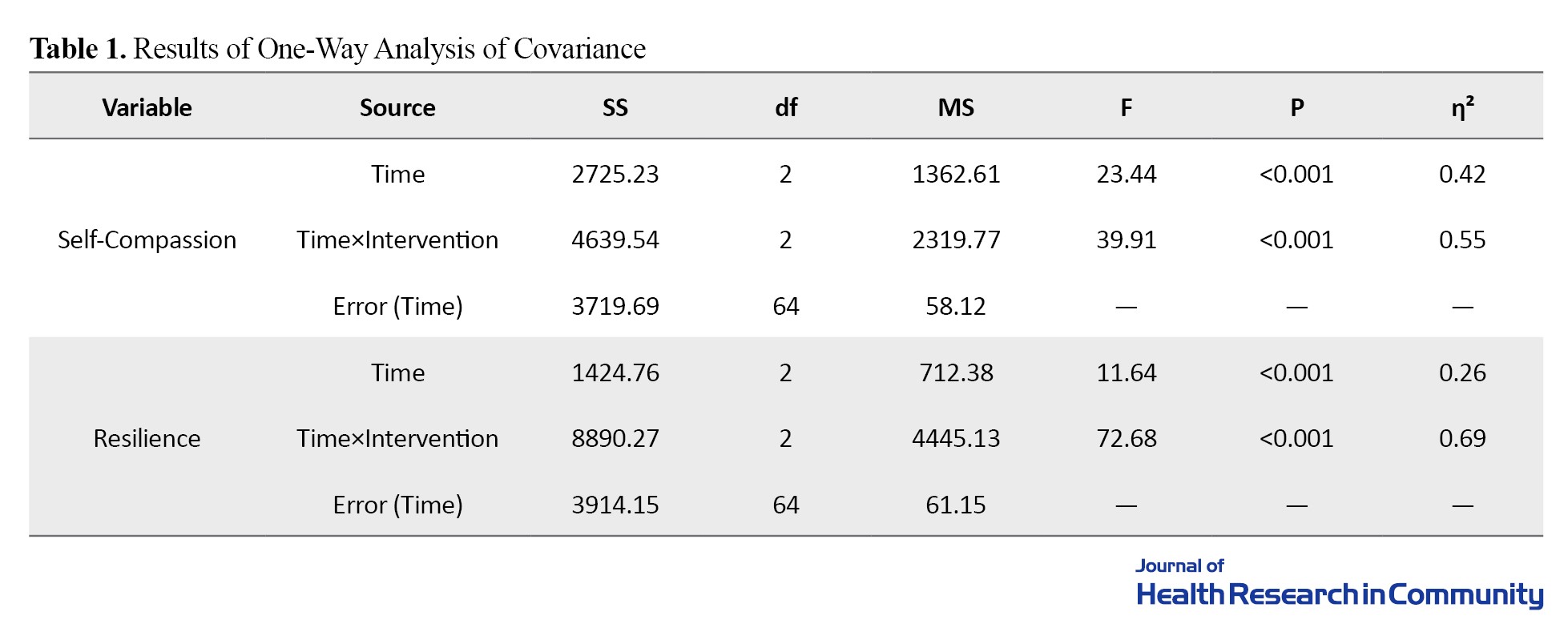
The effect size values indicated that 55% of the changes in self-compassion scores (i.e., the observed increase) can be attributed to mindfulness-based reality therapy training. For resilience, this value was 69%, also showing an increasing trend. Furthermore, the time×group interaction effect on self-compassion and resilience scores was significant (≥0.05), indicating that the differences in mean scores of these variables across the assessment stages were significantly influenced by the implementation of the mindfulness-based reality therapy intervention.
Conclusion
The present study examined the effectiveness of mindfulness-based reality therapy (MBRT) training on self-compassion and resilience in students with Internet addiction. The results indicated increases in self-compassion and resilience scores, accompanied by a reduction in Internet addiction scores. Self-compassion can reduce addictive behaviors by decreasing rumination and improving emotion regulation. MBRT exercises, by enhancing awareness of negative thoughts and feelings and fostering a kind attitude toward oneself, help reduce problematic Internet use. Moreover, resilience, as a protective factor, is negatively associated with Internet addiction. The goal is for individuals to make creative decisions in the present moment rather than reacting automatically. MBRT strengthened resilience by increasing emotional self-regulation. Resilience, by improving peer relationships, mediates part of its effect on reducing Internet addiction. Therefore, MBRT is a suitable and effective training program for enhancing self-compassion and resilience, aimed at reducing and preventing Internet addiction in students affected by this problem.
This study faced several limitations, including the lack of complete control over environmental, familial, and social variables, and the restriction of the sample to students from a single region. In addition, the extended duration of sessions and repeated use of assessment tools may have influenced participants’ responses. Despite the positive results in improving self-compassion, resilience, and reducing Internet addiction, future research with larger and more diverse samples, examining mediating variables, and comparing with other therapeutic approaches is recommended to enhance the generalizability and sustainability of the intervention.
Ethical Considerations
Compliance with ethical guidelines
This study was approved by the Ethics Committee of Arak Branch, Islamic Azad University (Code: IR.IAU.ARAK.REC.1403.306).
Funding
This research did not receive any specific grant from funding agencies in the public, commercial, or not-for-profit sectors.
Authors contributions
Conceptualization, data collection and organization, and drafting of the article: Mehdi Khodadadi; Study design, proposal revision, and research methodology development, project management, article revision and editing, data analysis, and interpretation of results: Hossein Davudi; Proposal revision, research conceptualization, review and evaluation of proposal content, review and editing: Hassan Heydari.
Conflicts of interest
There are no conflicts of interest in this study.
Acknowledgments
The authors sincerely express their gratitude and appreciation to all professors, students, parents, and education officials of Fereydunshahr County who participated in this study.
References
Since the introduction of the Internet in the 1980s, this technology has become an integral part of the daily lives of many people. Globally, the 15–24 age group has greater access to the Internet than other age groups, and students constitute a significant portion of these users, accounting for nearly one-third of them [1]. Considering the growing prevalence of Internet addiction, especially among adolescents [20], the need to design and implement various programs to prevent and treat problematic Internet use—aimed at reducing its negative consequences and impacts—has become more pressing than ever. Self-compassion and resilience are considered protective factors against the psychological harms caused by Internet addiction. Despite the popularity of integrating mindfulness into therapy, limited research has explored how mindfulness can be integrated with reality therapy or choice theory. Accordingly, this study sought to answer the question of whether mindfulness-based reality therapy training is effective in improving self-compassion and resilience among students with Internet addiction.
Materials & Methods
The present study employed a quasi-experimental method with a pretest–posttest design and an unequal control group. The statistical population consisted of all students in high school’s second stage (10th, 11th, and 12th grades; a total of 404 students) in Fereydunshahr during the 2023–2024 academic year. From this population, 34 students were selected through non-random convenience and purposive sampling and were then randomly assigned to two groups— an experimental group and a control group (17 participants in each group).
Three questionnaires were used for data collection. The 20-item Internet Addiction Test (YIAT20), developed by Young in 1996, was used to assess the level of Internet dependence. In the present study, the Cronbach’s alpha for the total scale was 0.853. The Connor-Davidson Resilience Scale (CD-RISC), designed by Connor and Davidson, was also employed. The Cronbach’s alpha coefficient obtained for this instrument in the present study was 0.804. The Self-Compassion Short Form (SCS-SF), developed by Raes et al. [40] and consisting of 12 items, was used to measure self-compassion. In the present study, the Cronbach’s alpha for the entire scale was 0.71, indicating acceptable reliability.
The mindfulness-based reality therapy intervention package was developed based on the educational protocol of Pierce [30] and implemented by the researcher in ten 90-minute sessions over two and a half months, with two sessions held each week. Inclusion criteria included no prior participation in reality therapy or mindfulness sessions, not being involved simultaneously in any other training or therapeutic program (as parallel interventions), and not receiving medication for reducing psychological problems. Exclusion criteria included absence from more than three sessions and relocation to another city.
Results
The means scores of self-compassion and resilience were calculated across the three stages: pre-test, post-test, and follow-up, separately for each group. The results indicated that in the post-test and follow-up stages, scores in the experimental group increased, whereas they decreased in the control group. A significant reduction in Internet addiction scores was also observed following the implementation of the intervention and at the three-month follow-up (a 5.95-point decrease in the mean Internet addiction score from 51.40 to 45.56 in the experimental group, and a 7.68-point increase from 37.32 to 45.00 in the control group). Since Wilks’ Lambda statistic was significant (≥0.05), repeated-measures analysis of variance was conducted to determine for which variables the differences between the two groups were significant. It should be noted that all required assumptions for this analysis were met in the present study. First hypothesis: Mindfulness-based reality therapy training is effective in improving self-compassion in students with Internet addiction. Second hypothesis: Mindfulness-based reality therapy training is effective in enhancing resilience in students with Internet addiction.
The results presented in Table 1 support the first and second hypotheses of the study.
The effect size values indicated that 55% of the changes in self-compassion scores (i.e., the observed increase) can be attributed to mindfulness-based reality therapy training. For resilience, this value was 69%, also showing an increasing trend. Furthermore, the time×group interaction effect on self-compassion and resilience scores was significant (≥0.05), indicating that the differences in mean scores of these variables across the assessment stages were significantly influenced by the implementation of the mindfulness-based reality therapy intervention.
Conclusion
The present study examined the effectiveness of mindfulness-based reality therapy (MBRT) training on self-compassion and resilience in students with Internet addiction. The results indicated increases in self-compassion and resilience scores, accompanied by a reduction in Internet addiction scores. Self-compassion can reduce addictive behaviors by decreasing rumination and improving emotion regulation. MBRT exercises, by enhancing awareness of negative thoughts and feelings and fostering a kind attitude toward oneself, help reduce problematic Internet use. Moreover, resilience, as a protective factor, is negatively associated with Internet addiction. The goal is for individuals to make creative decisions in the present moment rather than reacting automatically. MBRT strengthened resilience by increasing emotional self-regulation. Resilience, by improving peer relationships, mediates part of its effect on reducing Internet addiction. Therefore, MBRT is a suitable and effective training program for enhancing self-compassion and resilience, aimed at reducing and preventing Internet addiction in students affected by this problem.
This study faced several limitations, including the lack of complete control over environmental, familial, and social variables, and the restriction of the sample to students from a single region. In addition, the extended duration of sessions and repeated use of assessment tools may have influenced participants’ responses. Despite the positive results in improving self-compassion, resilience, and reducing Internet addiction, future research with larger and more diverse samples, examining mediating variables, and comparing with other therapeutic approaches is recommended to enhance the generalizability and sustainability of the intervention.
Ethical Considerations
Compliance with ethical guidelines
This study was approved by the Ethics Committee of Arak Branch, Islamic Azad University (Code: IR.IAU.ARAK.REC.1403.306).
Funding
This research did not receive any specific grant from funding agencies in the public, commercial, or not-for-profit sectors.
Authors contributions
Conceptualization, data collection and organization, and drafting of the article: Mehdi Khodadadi; Study design, proposal revision, and research methodology development, project management, article revision and editing, data analysis, and interpretation of results: Hossein Davudi; Proposal revision, research conceptualization, review and evaluation of proposal content, review and editing: Hassan Heydari.
Conflicts of interest
There are no conflicts of interest in this study.
Acknowledgments
The authors sincerely express their gratitude and appreciation to all professors, students, parents, and education officials of Fereydunshahr County who participated in this study.
References
- Joshi R, Pavithra N, Singh CK. Internet an integral part of human life in 21st century: A review. Curr J Appl Sci Technol. 2022; 41(36):12-18. [DOI:10.9734/cjast/2022/v41i363963]
- Alimoradi Z, Lin CY, Broström A, Bülow PH, Bajalan Z, Griffiths MD, et al. Internet addiction and sleep problems: A systematic review and meta-analysis. Sleep Med Rev. 2019; 47:51-61. [DOI:10.1016/j.smrv.2019.06.004] [PMID]
- Fendel JC, Schmidt S. Mindfulness for internet use disorder: A study protocol of a systematic review and meta-analysis. BMJ Open. 2022; 12:e067357. [DOI:10.1136/bmjopen-2022-067357] [PMID]
- Jaishy R, Maggu G, Srivastava M, Srivastava M, Chaudhury S, Saldanha D. Internet addiction and its effects on psychological wellbeing: A community-based study. Ind Psychiatry J. 2022; 32. [DOI:10.4103/ipj.ipj_61_22] [PMID]
- Hammond CJ, Mayes LC, Potenza MN. Neurobiology of adolescent substance use and addictive behaviors: treatment implications. Adolesc Med State Art Rev. 2014; 25(1):15-32. [DOI:10.1542/9781581108903-neurobiology] [PMID]
- Anjana Nannatt, Ngaitlang Mary Tariang. Adolescent Health in the Digital Age: Internet use and Addiction. Indian J Nat Sci.16(89):92704-16. [Link]
- Irannejad E, Mesbahi M, Rahimi G. [The relationship between self-compassion and internet addiction with the mediating role of stress coping strategies in the University Students (Persian)]. MEJDS. 2022; 12:95-95. [Link]
- Mamsharifi P, Akbari Bejandi N, Asadi N. [Internet addiction prediction modeling based on quality of life and life satisfaction: the mediating role of stress coping strategie (Persian)]. J Psychol Sci. 2020; 19(89):541-51. [Link]
- Zhu Y, Chen H, Li J, Mei X, Wang W. Effects of different interventions on internet addiction: A systematic review and network meta-analysis. BMC Psychiatry. 2023; 23(1):921. [DOI:10.1186/s12888-023-05400-9] [PMID]
- Porzoor P, Hajipour M. [Predicting Mobile phone addictive behavior in students based on emotional self-regulation, self-compassion, and attachment styles to God (Persian)]. Journal of School Psychology. 2023; 12(2):58-45. [DOI:10.22098/jsp.2023.2438]
- Gilbert P. Compassion: Concepts, research, and applications. London: Routledge; 2018. [DOI:10.4324/9781315564296]
- Neff KD, Dahm KA. Self-compassion: What it is, what it does, and how it relates to mindfulness. In: Ostafin BD, Robinson MD, Meier BP, editors. Handbook of mindfulness and self-regulation. Springer Science; 2015. [DOI:10.1007/978-1-4939-2263-5_10]
- Mottaghi Sh, Gholami T, Farzan M. [Prediction of Internet addiction based on resilience and motivational self-talk in adolescents (Persian)]. Journal of Social Psychology. 2023; 10(66):125-37. [Link]
- Touloupis T, Athanasiades C. Internet addiction among psychology students: The role of resilience and perceived economic hardship. Psychol J Hell Psychol Soc. 2022; 27(1):175-93. [Link]
- Zhao Y, Xu J, Zhou J, Zhang H. Resilience and internet addiction: A moderated mediation model of loneliness and resting respiratory sinus arrhythmia. Cyberpsychol Behav Soc Netw. 2022; 25(12):828-33. [DOI:10.1089/cyber.2022.0059] [PMID]
- Cao Q, An J, Yang Y, Peng P, Xu S, Xu X, et al. Correlation among psychological resilience, loneliness, and internet addiction among left-behind children in China: A cross-sectional study. Curr Psychol. 2022; 41. [DOI:10.1007/s12144-020-00970-3]
- Al Omari O, Al Yahyaei A, Wynaden D, Damra J, Aljezawi M, Al Qaderi M, et al. Correlates of resilience among university students in Oman: A cross-sectional study. BMC Psychol. 2023; 11(1):2. [DOI:10.1186/s40359-022-01035-9] [PMID]
- International Telecommunications :union:. Measuring digital development: Facts and figures [Intenet]. 2022 [Updated 29 February 2024]. Available from: [Link]
- Del Baldo M. Acting as a benefit corporation and a B Corp to responsibly pursue private and public benefits: The case of Paradisi Srl (Italy). Int J Corp Soc Responsib. 2019; 4(1):1-18. [DOI:10.1186/s40991-019-0042-y]
- Guerrini Usubini A, Terrone G, Varallo G, Cattivelli R, Plazzi G, Castelnuovo G, et al. The mediating role of emotion dysregulation and problematic internet use in the relationship between negative affect and excessive daytime sleepiness: A structural equation model. Nat Sci Sleep. 2022; 14:291-302. [DOI:10.2147/NSS.S346485] [PMID]
- Yang X, Hu H, Zhao C, Xu H, Tu X, Zhang G. A longitudinal study of changes in smartphone addiction and depressive symptoms and potential risk factors among Chinese college students. BMC Psychiatry. 2021; 21(1):252. [DOI:10.1186/s12888-021-03265-4] [PMID]
- Mitsea E, Drigas A, Skianis C. Digitally assisted mindfulness in training self-regulation skills for sustainable mental health: A systematic review. Behav Sci. 2023; 13(12):1008. [DOI:10.3390/bs13121008] [PMID]
- Lan Y, Ding JE, Li W, Li J, Zhang Y, Liu M, et al . A pilot study of a group mindfulness-based cognitive-behavioral intervention for smartphone addiction among university students. J Behav Addict. 2018; 7(4):1171-6. [DOI:10.1556/2006.7.2018.103] [PMID]
- Salmon PG, Santorelli SF, Kabat-Zinn J. Intervention elements promoting adherence to mindfulness-based stress reduction programs in the clinical behavioral medicine setting. In: Shumaker SA, Schron EB, Ockene JK, McBee WL, editors. The handbook of health behavior change. New York: Springer Publishing Company; 1998. [Link]
- Debb S, Colson D, Hacker D, Park K. Applying the Connor-Davidson Resilience Scale for use with third-year African American college students. J Negro Educ. 2018; 87:73. [DOI:10.7709/jnegroeducation.87.1.0073]
- Williams JMG, Duggan DS, Crane C, Fennell MJ. Mindfulness-based cognitive therapy for prevention of recurrence of suicidal behavior. J Clin Psychol. 2006; 62(2):201-10. [DOI:10.1002/jclp.20223] [PMID]
- Lau MA, McMain SF. Integrating mindfulness meditation with cognitive and behavioural therapies: The challenge of combining acceptance-and change-based strategies. Can J Psychiatry. 2005; 50:863-9. [DOI:10.1177/070674370505001310] [PMID]
- Liu X, Jiang J, Zhang Y. Effects of logotherapy-based mindfulness intervention on internet addiction among adolescents during the COVID-19 pandemic. Iran J Public Health. 2021; 50(4):789-97. [DOI:10.18502/ijph.v50i4.6005]
- Cayoun B. A four-stage model of mindfulness-based cognitive behaviour therapy for crisis and intervention and relapse prevention. Paper Presented at: Australian Association for CBT National Conference. 2005. Manuscript submitted for publication. [Link]
- Pierce J. Mindfulness based reality therapy (MBRT). Int J Reality Ther. 2003; 23(1):40-1. [Link]
- Whitfield HJ. Towards case-specific applications of mindfulness-based cognitive-behavioural therapies: A mindfulness-based rational emotive behaviour therapy. Couns Psychol Q. 2006; 19(2):205-17. [DOI:10.1080/09515070600919536]
- Hayes S, Strosahl K, Wilson KG. Acceptance and commitment therapy: The process and practice of mindful change. New York: Guilford Press; 2011. [Link]
- Linehan M. Cognitive-behavioral treatment of borderline personality disorder. New York: Guilford Press; 1993. [Link]
- Linehan MM. Skills training manual for treating borderline personality disorder. New York: Guilford Press; 1993. [Link]
- Gehart DR, McCollum EE. Engaging suffering: Towards a mindful re-visioning of family therapy practice. J Marital Fam Ther. 2007; 33(2):214-26. [DOI:10.1111/j.1752-0606.2007.00017.x] [PMID]
- Pedigo TW, Robey P, Christiansen T. An Integration of Mindfulness with Choice Theory and Reality Therapy. In: International Journal of Choice Theory and Reality Therapy. 2016. [Link]
- Kuss DJ, Griffiths MD, Karila L, Billieux J. Internet addiction: A systematic review of epidemiological research for the last decade. Curr Pharm Des. 2014; 20(25):4026-52. [DOI:10.2174/13816128113199990617] [PMID]
- Alavi SS, Jannatifard F, Eslami M, Rezapour H. [Survey on validity and reliability of diagnostic questionnaire of internet addiction disorder in students users (Persian)]. Zahedan J Res Med Sci. 2011; 13(7):34-8. [Link]
- Keyhani M, Taghvaei D, Rajabi A, Amirpour B. [Internal Consistency and Confirmatory Factor Analysis of the Connor-Davidson Resilience Scale (CD-RISC) among Nursing Female (Persian)]. Iran J Med Educ. 2015; 14(10):857-65. [Link]
- Raes F, Pommier E, Neff KD, Van GD. Construction and factorial validation of a short form of the self-compassion scale. Clin Psychol Psychother. 2011; 18(3):250-5. [Link]
- Khanjani S, Foroughi AA, Sadghi K, Bahrainian SA. [Psychometric properties of Iranian version of self-compassion scale (short form) (Persian)]. Pejouhandeh. 2016; 21(5):282-9. [Link]
- Wisener M, Khoury B. Is self-compassion negatively associated with alcohol and marijuana-related problems via coping motives? Addict Behav. 2020; 111:106554. [DOI:10.1016/j.addbeh.2020.106554.] [PMID]
- Boonlue T, Sillence E. Self-compassion, psychological resilience, and social media use among Thai and British university students. J Soc Sci Humanit. 2021;47:9-28. [Link]
- Dewsaran-van der Ven C, van Broeckhuysen-Kloth S, Thorsell S, Scholten R, De Gucht V, Geenen R. Self-compassion in somatoform disorder. Psychiatry Res. 2018; 262:34-9. [DOI:10.1016/j.psychres.2017.12.013] [PMID]
- MacBeth A, Gumley A. Exploring compassion: A meta-analysis of the association between self-compassion and psychopathology. Clin Psychol Rev. 2012; 32(6):545-52. [DOI:10.1016/j.cpr.2012.06.003] [PMID]
Type of Study: Research(Original) |
Subject:
Psychology
Send email to the article author
| Rights and permissions | |
 |
This work is licensed under a Creative Commons Attribution-NonCommercial 4.0 International License. |
